



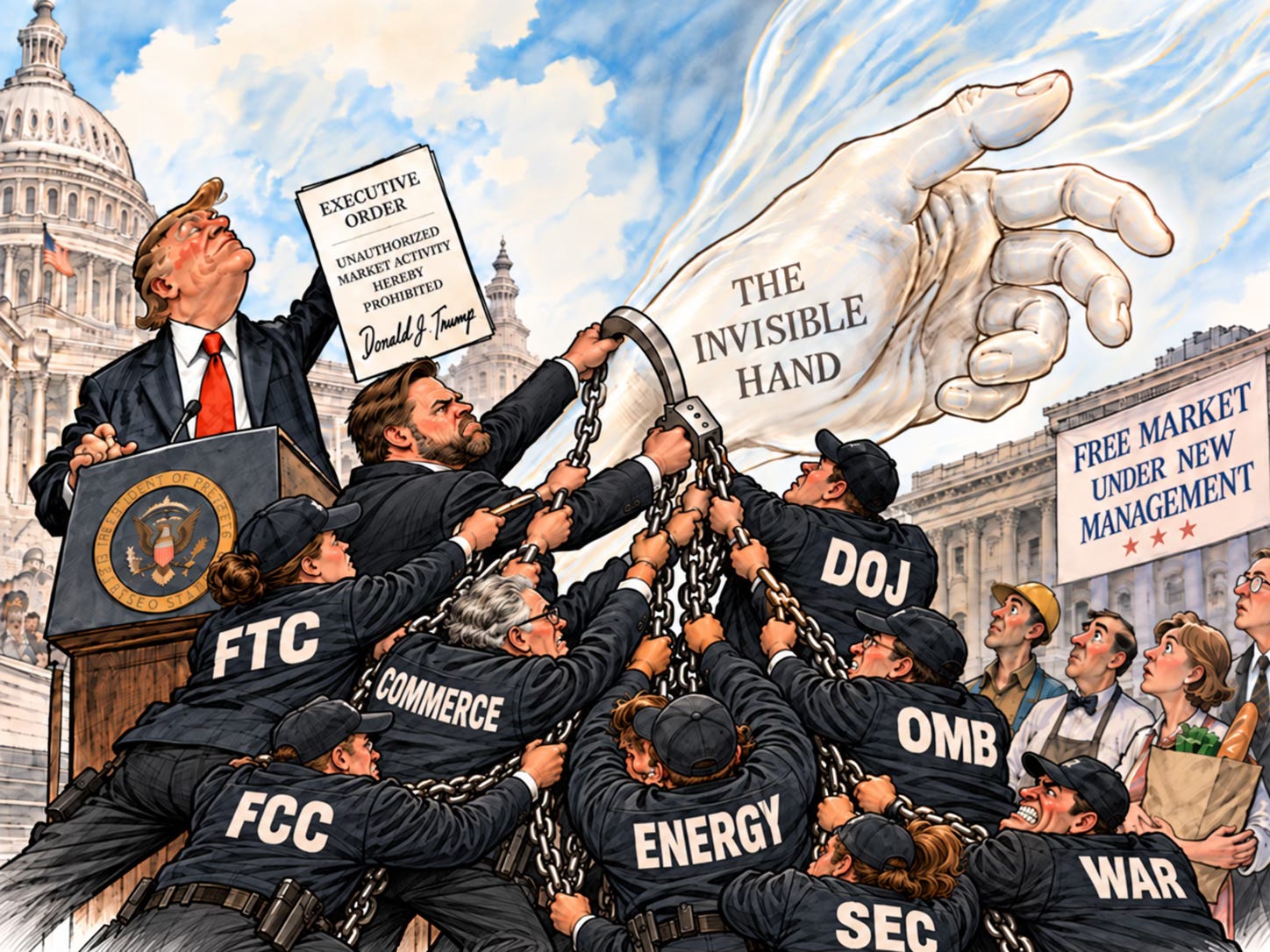
We’ve been writing about what we call “conservative socialism”—the growing willingness on the right to use government power to manage the economy. A new Wall Street Journal poll suggests the problem is bigger than we thought.
The Journal asked voters about more than 30 proposals now circulating in Washington and the states. Eighty-seven percent support capping prescription-drug prices. Seventy-nine percent would limit credit-card interest to 10 percent. Seventy-four percent favor capping child-care costs for working families, and 75 percent want to stop large institutional investors from buying up single-family homes.
These ideas no longer belong only to the progressive left. The 10 percent credit-card cap has Josh Hawley on the same side as Bernie Sanders, and The Journal suggests we are witnessing the emergence of a new bipartisan populism. Maybe so, though the label says little about the economics underneath.

Are conservatives are losing faith in markets just when America needs people who understand and appreciate them the most? The argument now too often starts with something unwelcome—high cost of prescription drugs, an expensive house, an American industry in trouble—and leaps straight to the conclusion that Washington should deliver a different result.
That’s a long way from the conservatism we grew up with. The conservatives who shaped our generation never thought that markets were perfect. But government, operating on politics and hunches, was decidedly imperfect. Prices carried information, incentives mattered, and scarcity didn’t go away because Congress disapproved of it. Government could shift costs onto someone else, but it couldn’t make those costs vanish. None of this sounds profound now, and that’s the problem. These used to be the working assumptions of conservative economic policy, and they’re slipping away.
Take the 10 percent credit-card cap. We would all much rather pay 10 percent on a credit-card balance than 25 percent. But that preference doesn’t tell us whether 10 percent makes sense as a legal ceiling.
Interest is the price of borrowing, and part of that price covers the chance the borrower won’t pay it back. Congress can forbid a lender from charging more than 10 percent. It can’t make the borrower any less of risk. So, some people now paying 20 or 25 percent will pay less, and many others will find the lender no longer willing to do business with them. The Journal itself notes that a 10 percent ceiling could lead card issuers to stop lending to lower-income borrowers who carry balances. That alone doesn’t settle the matter, but it shows the question is harder than whether 10 percent beats 25.
The same habit shows up across our economic politics. Houses cost too much, so keep institutional investors from buying them. Drugs cost too much, so cap the price on drugs (and why not on childcare, too?). Foreign competitors are hurting American manufacturers, so let’s impose tariffs. An industry is strategically important, so we should subsidize it. A company does something Washington dislikes, so the government takes a financial stake or attaches political conditions to how it operates.
Some government interventions may have a national security justification behind them. China’s predatory mercantilism sometimes forces us to protect ourselves with some elements of industrial policy—such as the ongoing public investment in the production of rare-earth minerals. Nor should “socialism” become a lazy insult for anything government does. Still, a shared assumption runs through these policies: when markets produce an outcome politicians of both parties dislike, government should swap it with the preferred result. That is what we mean by conservative socialism.
Conservative socialism thus doesn’t require nationalizing General Motors or putting bureaucrats in charge of steel mills. Modern government has subtler tools. It can subsidize some firms and tax others, shield favored industries from competition, set prices, limit who may buy certain assets, take stakes in private companies, and make regulatory approval depend on promises about jobs, output or investment. The companies stay private on paper, while more and more of their important decisions get made by politicians.
What strikes us as strange is watching conservatives adopt this outlook, given how much effort an earlier generation of them spent explaining its dangers.
Friedrich Hayek’s case against planning wasn’t that planners were always stupid or ill-intentioned. It was that no planner could ever hold the information needed to make all those decisions.
That knowledge is scattered across the whole economy, and prices are the efficient way it travels. Milton Friedman kept coming back to incentives—you can’t judge a policy by announcing what it’s supposed to do, because people, firms and consumers all respond to it, sometimes in ways that undo its purpose.

Judge Robert Bork made a similar argument about antitrust. In his view the field had turned into judges and academics deciding which economic arrangements they found desirable. He wanted to pull antitrust back to a plainer question to one simple metric—does a business deal benefit or harm consumers? We could use such intellectual discipline over policy again.
A high price doesn’t by itself prove anyone did anything wrong. Sometimes it does point to monopoly, and anticompetitive conduct should be prosecuted when the law and the facts support it. But prices also rise because of scarcity, higher demand, higher costs or greater risk. Until we know why a price is high, we’re in no position to say what government ought to do about it.
The poll includes a telling remark from Republican pollster Adam Geller. What many of these populist proposals share, he says, is the perception that some large institution is standing between the voter and a “fair price.”
But what’s the fair price of a mortgage loan, or of an apartment in Manhattan? What’s a fair interest rate on a card issued to someone with bad credit, but hoping to start a small business that would quickly pay off the interest? What’s the fair price of a drug that took several billion dollars to develop and costs pennies a dose to make? Some of those questions may have good answers. We doubt that handing them to politicians improves the odds of finding them.
Michael Strain of the American Enterprise Institute makes what may be the article’s most trenchant point: “When conservatives become undisciplined by the need to respect market forces, they end up sounding a lot like progressive Democrats.”
None of this means conservatives should ignore the problems that made populism appealing. Housing really is out of reach for many Americans. Medical care is extraordinarily expensive, and credit-card debt can crush a family. People are right to ask why a country this prosperous can’t do better. Conservatives need to return to the answers to these problems they already have.
Over five decades of deep investment in free-market and conservative think tanks, the right has developed detailed, market-based solutions to the high costs of housing (clear the red tape to build more houses), tuition (quit subsidizing bureaucracies like that of Stanford University, which has more administrators than undergraduates), healthcare (put the consumer in charge and make providers compete), and other essential goods. Yet the Republican Party has walked away from this heritage of sound policies. A particularly powerful wedge issue for Republicans is bringing competition to failing public schools. We won’t belabor these issues here, but any one of these policy approaches would appeal to Americans’ common sense and put the Democrats on their back heels.

There’s danger in Republicans rejecting their intellectual heritage. Once conservatives accept that Washington should manage economic outcomes, the fight is no longer over whether government should have that power, only over who gets to wield it. Conservatives may want tariffs, manufacturing subsidies or limits on institutional investors today; progressives have a list of their own, and the machinery serves either side equally well. Conservatives used to say it often: don’t hand government a power you wouldn’t trust your opponents with. The advice still holds.
Late in The Journal piece, Democratic pollster Evan Roth Smith says voters have “no interest in entertaining the point of view of traditional political economics, because it has failed them entirely.” Conservatives would be foolish to wave that anger away. If millions of Americans think the economy has stopped working for them, telling them to go read Milton Friedman won’t do as a political program. Neither will pretending Friedman was wrong about incentives.
Conservatives need candid, no-BS answers for people who can’t afford a house, who lie awake over medical bills, and who suspect their children will struggle harder for a middle-class life than they did. Borrowing the left’s economic assumptions and putting conservative politicians in charge of carrying them out isn’t that answer. Whatever we called it, it would be central planning, just under new management.
A final point: conservative socialism is doomed to fail on two counts. If socialism is the answer, then why not go with politicians who have always been the real deal? One of us once asked a veteran political consultant on the right why he wasn’t supporting a liberal Republican against his radically liberal opponent? He replied, “I don’t like to drink socialism, but if I ever do, I would like it neat.” The second problem is that when conservative socialism is actually tried, it too will eventually run out of other people’s money.