


Editor’s Note: Did it seem like DEI (Diversity, Equity, and Inclusion) initiatives sprang out of nowhere? Or that a giant, multibillion-dollar sector of diversity training seemed to suddenly emerge from that same nowhere to teach Americans to walk on eggshells?
In fact, these trends were a long time in the making, germinating in law since the 1990s. Gail Heriot, a legal scholar who has served on the U.S. Commission on Civil Rights, explains how a law passed in 1991 incentivized a “woke” approach to race and sex, replacing the venerable quest for equality with the nebulous concept of “equity.”
The following is a lightly edited version of speech Professor Heriot gave last December at Cornell University.
Sometimes the nation gets swept away by sudden enthusiasms for which there is no real explanation—like pet rocks, the Macarena, or fidget spinners. They seem to come out of nowhere. But very few things are like that. Most trends, including those of an ideological nature, have a cause or (more commonly) a constellation of causes. And they build over time. The “woke ideology”—which I’ll be talking about a bit this evening—is no exception.
I think most of you have some sense of what I mean by “woke ideology.” It’s not just about being sensitive to whatever special challenges that are thought to be faced by women and minorities, although that’s part of it. It’s a set of beliefs—central among them that when group outcomes differ by race, it’s the result of the nation’s long and continuing history of racism. The same goes for differences based on sex and other identity factors. Those who subscribe to the woke ideology tend to reject laws that require that individuals be treated equally regardless of race or other identity factors on the ground that those laws are insufficient to equalize group outcomes.
If you believe (and spoiler alert, I do not) that racism, sexism, and the like really are the cause of, well, everything, then I suppose that’s an explanation enough for the intense popularity of the woke ideology in the last decade or so—women and racial minorities finally have gotten wise to it all and they’re not goin’ to take it anymore.
But if you’re like me and like most Americans, it just doesn’t seem to jibe with the America we see around us—a country that is imperfect, but nevertheless fundamentally decent and in some ways exceptional. We’re looking for a different and better explanation.
The 1991 Civil Rights Act
I don’t believe anyone can give an exhaustive explanation for the Woke Era in a short space. Any such explanation would have to look at the issue from many angles: demographic, economic, ideological, technological. My aim is more modest. I want to talk about the contribution made by the area I know best—civil rights law and policy. In particular, I want to concentrate on one law, the Civil Rights Act of 1991. Its special ability to cause Americans with conservative, libertarian, and centrist views on race and sex to feel they must walk on eggshells has been a significant contributing factor to the Age of Wokeness and quite possibly the age of Trump too.
What happens when people in the center and right two-thirds of the political spectrum are made to be especially uncomfortable in speaking about issues of race and sex? The answer to that should be obvious. Overwhelmingly, they clam up, so a large swath of the population starts to sound like a fringe group. Meanwhile, free from substantial criticism, the ideas that start out somewhat left-of-center slowly evolve to be quite left-of-center, then far-left, and eventually, in my opinion, into woke unreality.
So let me tell you a little about the Civil Rights Act of 1991 and why I think it caused people to clam up. You are to be forgiven if you’ve never heard of it. Unlike the landmark Civil Rights Era legislation of the 1960s, it doesn’t get a lot of mention these days. And I don’t recommend that you put it on your summer reading list. It reads a bit like the Tax Code. But like the Tax Code, it created incentives that have had a real impact on our lives.
A Brief History
When it was signed into law by President George H.W. Bush in 1991, it contained many provisions, some ok, some not-so-ok, and some maybe well-meaning but quite terrible. In retrospect its most important provisions were the ones that made employers who intentionally discriminate liable for emotional distress and punitive damages. To be sure, there were caps on the amounts that could be recovered, caps put there at the insistence of the Bush Administration and still in effect today (though a bill was recently introduced in Congress that would remove the caps). No one could get more than $300,000 in combined emotional distress and punitive damages. And for cases against very small businesses the cap was lower. Still, the amounts were more than enough to grab the attention of most employers. And for reasons that I’d need an extra three hours to explain, the caps did not apply to cases involving racial harassment or discrimination. These changes significantly raised the financial stakes for most employment discrimination cases. That matters.
Here’s the way it worked: Beginning in the 1970s, courts began to view certain kinds of workplace interactions—deemed to be “harassment”—as Title VII violations. During that period, however, the largest sum of actual money a plaintiff could hope to receive for winning a Title VII lawsuit would have been the value of the wages lost as a result of the violation. They might be able to get an injunction too, but that’s not money. Since only serious harassment was likely to result in lost wages or the desire for an injunction, harassment lawsuits were relatively uncommon. The new provisions for emotional distress and punitive damages in the ’91 Act greatly expanded the array of racial and sexual harassment cases that could be worth a plaintiff’s time and energy to litigate.
In some sense, of course, that is exactly what the Act’s supporters wanted. More lawsuits and higher damages could mean more effective deterrence, or so the Act’s supporters hoped. What Congress probably didn’t bargain for was how overwhelming the deterrent effect would be.
But think about it: Harassment was and is an ill-defined concept. By adding the possibility of significant financial gain, the new law invited aggressive efforts to expand what could fit into that concept. The uneasiness this caused for employers is easy to understand.
The most fundamental reason for the law’s disproportionate deterrent effect was the cumulative nature of harassment. As the Supreme Court interpreted the law, a thousand pinpricks, no one of which is serious in itself, could add up to a violation. Those pinpricks wouldn’t have to come from the same person. A sexual harassment case could be made up of a rude remark from one colleague, an annoying stare from another, and a sexy cartoon anonymously pinned to a bulletin board. Individually, those pinpricks would have no legal effect. But together, at some undefined tipping point, they could create liability for the employer.
Racial harassment was no different. At some undetermined point, one colleague’s imprudent race-based teases, another’s controversial reading material at lunchtime, combined with yet another’s objection to an affirmative action plan, could put the employer in the firing line of a lawsuit.
Once the ‘91 Act passed, jittery employers correctly understood that to avoid costly lawsuits they needed to control employee speech and conduct at the pinprick level. There was no other way.
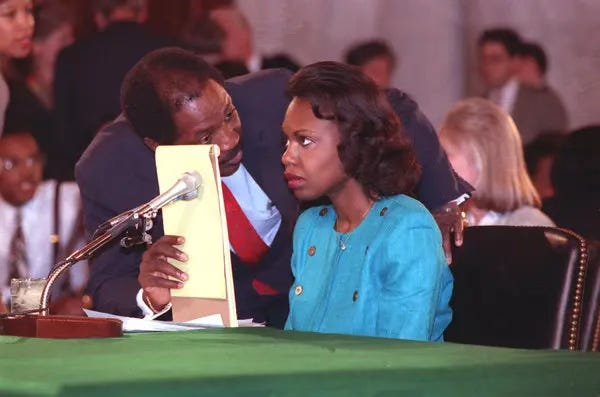
It wouldn’t be fair to say that the Bush Administration was asleep at the wheel when this was happening. Bush had actually vetoed an earlier (and worse) version of the bill—called the Civil Rights Act of 1990—and his Congressional allies and Administration lawyers were prepared to hang tough to get a bill that would be acceptable to them. But a funny thing happened while the new version—the one that Bush eventually signed into law—was being negotiated: Bush nominated Clarence Thomas to the Supreme Court. Then, suddenly, Anita Hill appeared to provide exactly the push the bill needed. In televised hearings, she accused Thomas of having pestered her for a date and having a bawdy sense of humor. The public was mesmerized to hear the subject being discussed in a stately Senate hearing room. Bill supporters finally had the high-profile case of sexual harassment had been hoping for. Bush’s political advisors told him that if he wanted to be re-elected, he needed to sign the bill. So he did, while his legal advisors looked on with worry, not knowing exactly what the fallout would be.
Title VII
Looking back over the years, I believe the fallout was extremely significant. It helped lead to endless woke DEI training and perhaps ultimately to the Age of Trump, though it wasn’t so clear at the time. Over the next 30 years, it did a lot to silence the voices of everyday Americans whose views are center-right. That in turn has done a lot to knock our civil rights policy off kilter.
But to understand that fallout, we need to back up to 1964 and see how Title VII was originally structured and how the ’91 Act upset that structure.
Allow me to do just that:
Under the original version of Title VII, the prohibition was worded very broadly. Any discrimination by employers, no matter how trivial, was technically a violation. So if a business that’s located in a cramped, old building has a slightly more conveniently located restroom for men than it does for women, it’s in violation.
Still, nobody with the gift of wisdom is going to want to make a federal case out of it. Fortunately, the way the statute was set up, we didn’t need to rely on people having that wisdom. First, an aggrieved individual would have to take the case first the EEOC for mediation. If she was dissatisfied with that mediation, she could take the case to court. But she could get only two possible remedies: lost wages or an injunction (or both). But minor cases rarely involve lost wages. As for injunctions, they could be useful—but they wouldn’t make the plaintiff rich, so they usually wouldn’t be enough to convince someone to sue who didn’t truly feel she’d been wronged. Moreover, they couldn’t be used in a situation where an employee had been fired for good reason and had therefore become angry and desperate, such that she “just remembered” that she’d been harassed and mistreated while still on the job. It’s too late to have the court fix the problem with an injunction. All this worked as a structural brake on Title VII.
My University of San Diego law students sometimes think that the reason Congress limited the remedies in 1964 was that they really didn’t care about ending discrimination. Alas, our students sometimes come to us already educated to believe the country is rotten to the core, so I guess it’s no surprise that they’d think that way. But that’s not it. Here’s one piece of evidence: Congress also gave Title VII plaintiffs one boon that’s unusual in American law: Successful plaintiffs could get the defendant to pay their attorneys’ fees. Congress understood that injunction cases don’t generate a pot of money out of which a contingency fee can be paid and they also understood that even in cases involving lost wages, low-income plaintiffs with perfectly good cases would sometimes have a hard time hiring an attorney because the amount of money involved would be too small to generate a significant contingency fee.
Lawyers and legal historians can often guess why Congress limited remedies the way they did. But if you’re not one, you’ll probably never guess: So I’ll tell you: Congress did it to make sure that employers wouldn’t have the right to a jury trial. For reasons involving the 17th century English distinction between “law” and “equity” that we needn’t go into now, jury trials aren’t available in cases involving injunctions and sometimes injunctions plus a little more. Congress was unconvinced that Title VII would be enforced by juries in Jim Crow states.
So that was the state of play in 1964: A extremely broad prohibition, narrow remedies designed to avoid jury trials (though not that narrow, since recovery for emotional distress and punitive damages is somewhat rare in the law). And all that was combined with an unusual provision allowing successful plaintiffs to recover for attorneys’ fees.
Was Title VII a perfect engine for the elimination of discrimination? Of course not. No law is ever has been. The only way to give the public perfect protection against violent crime is to have a police state. The only way to give the public perfect protection against ever-dreaded misinformation is to shut down discussions that a free society needs. The original version of Title VII wasn’t perfect, but it was serviceable.
As an aside: Just in case some of you are the kind who think that the law can work miracles, let me urge you never lose sight of the fact that our best protection against employer abuse including discrimination is a strong, competitive economy. With it, everyone can prosper. If instead the economy goes to hell, all bets are off. All the worker-protection laws in the universe won’t help us. Anti-discrimination laws are a good supplement when the economy is somewhere between terrific and terrible and especially when entrenched laws and practices have disrupted what otherwise would have been a competitive economy, but it’s only a supplement.
And I would submit that, all things considered, we made things worse when we amended Title VII to make lawsuits more lucrative. In the early 1990s, harassment lawsuits brought under Title VII skyrocketed. Employers panicked. Everything that anybody might consider offensive had to be eliminated. And the Supreme Court, in what appears to have been an effort to throw employers a lifeline, told them that if they can just set up procedures under which employees can have their complaints investigated and dealt with, and if they can just train their employees to avoid harassment, they would to a certain extent be protected from liability.
Where This Got Us
“A little more than 10 years ago a good friend of mine, somebody whose stock in trade is largely to detect public opinion, told me with great assurance that very few voters were interested in the immigration issue. Just a few disgruntled populists, but for the vast majority of voters it was at the bottom of the list. A year or two later, Trump descended on the escalator.”
So what do you think you’re going to get under such circumstances? You’re going to get an in house bureaucracy to field complaints and micro-manage human relations from afar. And you’re going to get training, training, and more training. Under the Supreme Court’s analysis, it didn’t matter if the training and the reporting procedures were effective; just having it would count in the employers’ favor.
This kind of training rapidly became a billion-dollar business and evolved into what we call DEI today. It’s no wonder employers would seek professionals—often the products of over-the-top university multi-cultural programs of the 1980s and 90s—to help them instruct their employees on how to avoid offense. Consider the number of words that people were finding racially insensitive in the 1990s and early 2000s “cakewalk,” “long time no see,” “master bedroom,” “no can do,” “plantation shutters,” and “peanut gallery.” There was a surprisingly widespread notion that the word “picnic” derives from lynching parties. “Picnic” was said to derive from “pick a [insert a derogatory name here]” to lynch. A Smithsonian staff member reported that at one point she was fielding several calls a day about this absurd belief.
One thing you can count on in life, big businesses want to stay in business, so they will keep inventing new things that just might cause offense. Thus the concept of micro-aggressions was popularized. In a pre-1991 Act world, employers and employees could laugh off hyper-sensitivity. But in a world where harassment is judged on a cumulative basis and in which hyper-sensitive employees may have a successful “retaliation” lawsuit under Title VII if they can prove that they’ve been discouraged from making complaints, employers can’t laugh off anything. Every complaint must be treated with kid gloves. The law thus encourages ever greater levels of sensitivity.
Among the so-called micro-aggressions that we’re now routinely warned not to say are those that can be interpreted to relate to affirmative action. Specifically, you can’t say:
“I believe the most qualified person should get the job.”
“As a [manager], I always treat men and women equally.”
Think about what that means. The animating principle behind Title VII when it passed in 1964 was “the most qualified person should get the job regardless of race, color, religion, sex or national origin.” The Supreme Court 15 years later in United Steelworkers v. Weber held that, well, the statute might say no discrimination, but it doesn’t really mean that. Discrimination in favor of under-represented minorities is okay sometimes—even morally upright! The dissent by Justice William Rehnquist rightly called the decision Orwellian; that is, an obvious case of judges deciding what they think the law should be rather than what it is. But that was nothing compared to the last decade or so during which even articulating Title VII’s animating principle—the most qualified person should get the job—can be viewed as harassing and hence a violation of the law.
Here are a few more of these standard-list microaggressions:
“Where are you from?”
“Where were you born?”
“Don’t say that!”, employees are instructed. And if you can’t say that, you sure can’t say to your colleagues—“I don’t think we need bring in more employees on a H1-B visas. There are plenty of qualified Americans out there.” And you sure don’t want to say, “We need to be more careful about not hiring undocumented workers.” Is it any wonder that employees who are opposed to affirmative action or who have concerns about immigration think they have to walk on eggshells? And if they can’t say these things at work, they can’t say them in public.
Let’s face it: It has always made most people uncomfortable to talk about race and sex (and I’ll include within that immigration). But the ’91 Act and diversity bureaucracy and relentless training that grew up around it made it exponentially worse.
And is it any wonder that politicians and commentators, when they don’t hear views from the center-right as often, get a mistaken view of where public opinion lies. Or that left-of-center ideas get flakier and flakier when they aren’t subject to criticism?
I picked up a copy of White Fragility: Why It’s So Hard for White People to Talk About Racism, the runaway bestseller by celebrity DEI trainer Robin DiAngelo a few years ago. The book purports to be a distillation of what she has learned over the course of her many years as a trainer. Her message amounts to this:
All the whites are the racist beneficiaries of white privilege, right down to the lowest paid WalMart warehouse worker forced to sit through her teaching.
Only whites can be racist.
Whites who complain about “‘reverse’ racism” are being “profoundly petty and delusional.”
If her trainees don’t docilely accept these teachings, they are displaying what she calls “white fragility.”

That’s pretty extreme. But the book sold 5 million copies, so somebody liked it. Still, if you can’t see how that will go over with a blue-collar white guy struggling to make ends meet in a dead-end job, you’re not trying.
The thing that struck me most about DiAngelo’s comments was that she was experiencing a lot less pushback around the time she wrote the book (which was published in 2018) than when she first started as a trainer many years prior. She attributes this to her many years of experience as a diversity trainer. Maybe. But I wonder if something else isn’t going on. As politically conservative and moderate employees were exposed to year after year of training, they were learning there’s nothing in it for them to talk back. They clam up. Polls show this quite clearly and may even underestimate the effect. Self-described moderates avoid speaking up almost as much as self-described conservatives. But just because they do so that doesn’t necessarily mean they change their views.
It does mean, however, that political leaders and commentators (who may well understand that the legitimacy of our form of government depends in large part on its ability to effectuate the will of the people) have a hard time. How can you even gauge the will of the people when there’s an imbalance of that kind?
Let me give you a couple of examples: A little more than 10 years ago a good friend of mine, somebody whose stock in trade is largely to detect public opinion, told me with great assurance that very few voters were interested in the immigration issue. Just a few disgruntled populists. But for the vast majority of voters, it was at the bottom of their list. A year or two later, Donald Trump descended on the escalator. It turned out that many voters were frustrated enough to vote for the guy they saw as the disrupter.

Here’s another example, one that involves work that I was involved with. Almost 30 years ago, in 1996, I co-chaired a California ballot initiative called Proposition 209. It amended the state constitution to include these words: “The State shall not discriminate against, or grant preferential treatment to, any individual or group on the basis of race, color, sex, ethnicity or national origin …” It was aimed at prohibiting the kind of preferential treatment we call “affirmative action.”
At the time, 30 years ago, we strongly suspected it would pass once it got on the ballot. And we weren’t the only ones who thought so. Our opponents must have thought so too, for they employed mostly disingenuous arguments against us, claiming the effect of the initiative would be to legalize sex discrimination. Even liberal newspapers admitted the argument was just plain silly. In the end, it did pass; and I’m proud to say it even made a history book or two.
Fast forward to the more recent past. The California Legislature had been trying to come up with a way to expunge Proposition 209 from the California Constitution for years. They liked having the power to discriminate. That’s not too weird. People in positions of power don’t like limitations on their power, and that’s what Proposition 209 did. What was weird was that they had convinced themselves that the voters wanted them to have it. It was gospel in Sacramento, even among some of the Republicans, that since California was a majority minority state, the people couldn’t wait to crank up the preferential treatment machine again. In 2020, in the midst of Woke Fever, the legislature made its move: It put a referendum on the ballot (known as Proposition 16) that would have repealed Proposition 209.
It flew through both houses as if it had wings. All the Democrats and even some Republicans voted for it.
A “NO on Prop 16” campaign, which I co-chaired, was quickly assembled. Everyone thought we would lose. Money poured into the campaign coffers of our opponents. They had more than 14 times more money than we had—almost every nickel of it in huge donations from major corporations, big unions and real estate moguls. And endorsements! They had Kamala Harris, Dianne Feinstein, Bernie Sanders, Gavin Newsom, Alex Padilla, Pete Buttigieg, Nancy Pelosi, more than two dozen members of the U.S. House of Representatives, and lots of big city mayors.
It wasn’t just politicians. The Golden State Warriors, the San Francisco 49ers, the San Francisco Giants, Lyft, Uber, Facebook, United Airlines, Wells Fargo, Yelp, and Instacart all endorsed Proposition 16. Plus the New York Times and every major California newspaper with the exception of the Orange County Register.
What did we have? We had hundreds of volunteers, many of them immigrants and children of immigrants who had come to this country precisely because they’d been told that American was the place they wouldn’t be discriminated against.
In the end, we shocked ‘em. Proposition 16 was defeated overwhelmingly—We got over 57% of the vote. Of course, our opponents immediately argued that the voters had simply misunderstood. But an important poll taken directly after the election proved otherwise. The politicians in Sacramento were simply out of touch. And I believe the ’91 Act was a highly significant contributing factor to that situation. We’re all trained not to talk about race and sex preferences.
Ok, so far I’ve mostly been saying that the ’91 created a culture that made it difficult for elected officials to understand where the voters were coming from. I don’t mean to suggest that the only thing. In addition, I believe the voters tended to be right about the core policy issues. For example, for reasons that I’d be happy to talk about if we had all week, I believe the public has it right that the only just and sustainable policy is that of race and sex neutrality: No preferential treatment based on race or sex. But it is perhaps easier to make my point in terms of a different issue—and that of criminal justice.
Criminal Justice
Five years ago, thousands of convicted criminals were emptied from the prisons on account of COVID. Teenage gang members were not in school. Then a few weeks later, the country went on a DEFUND THE POLICE kick and this was argued for (mostly by people who live in higher-income safer neighborhoods) as necessary to protect African Americans whose neighborhoods were said to be “over-policed” from police brutality. It was a time we could have used MORE police protection, not less. But we got less. Most Americans understood that it would have the opposite effect. That those living in low-income African American neighborhoods would suffer most of all. But very few were willing to say so out loud. And sure enough, that’s what happened.
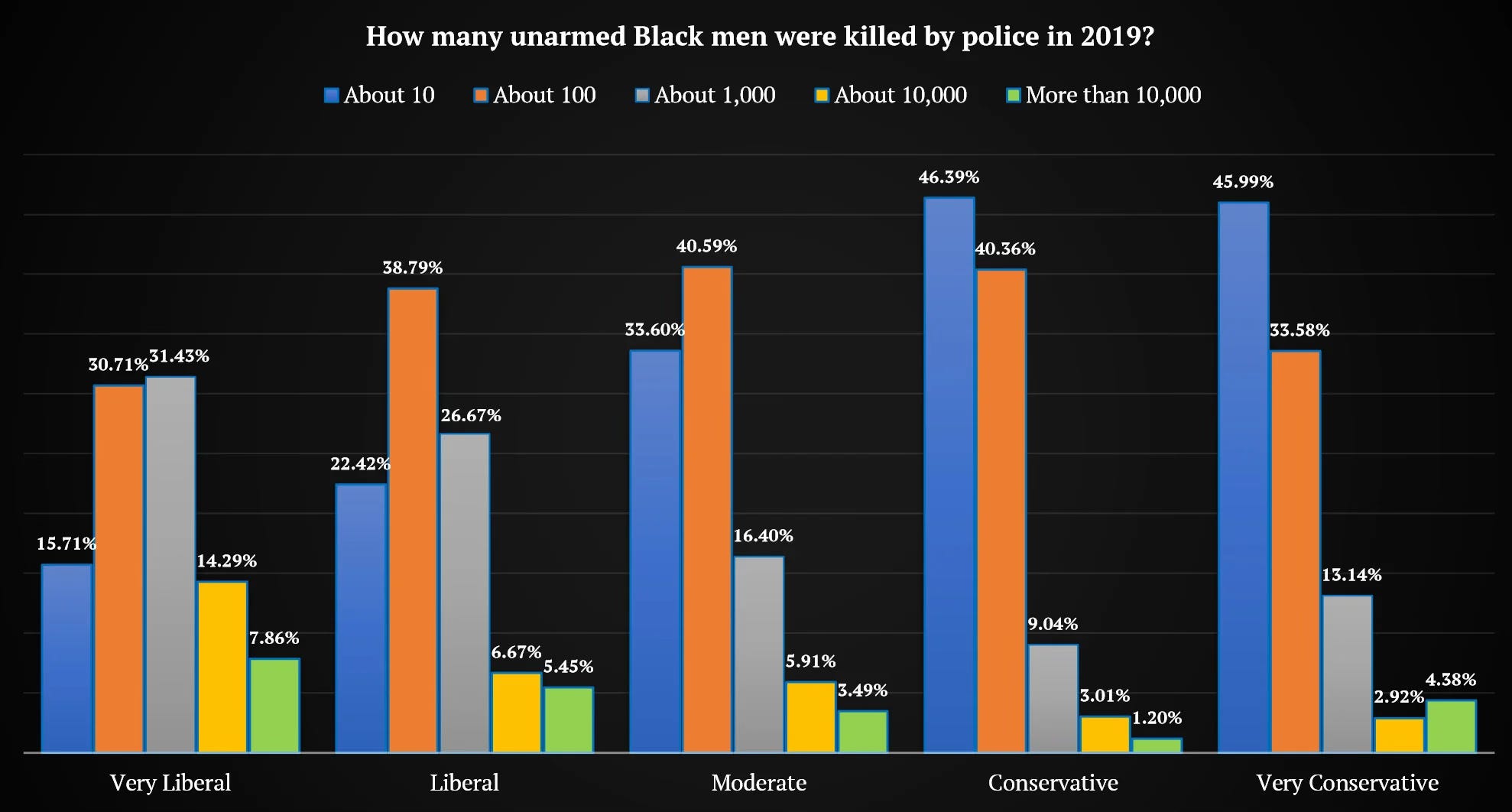
Part of the problem is that left-of center voters don’t have the facts right. A national survey conducted in 2019 found that nearly 44% of self-described liberals believed that an alarming 1000 or more unarmed African American men had been killed by police in that year alone. But those estimates were wildly off. The true number was 29 that year. Not 1000, 29.
Similarly, a 2020 survey found that 60% of highly educated white liberal respondents believed that young African American men were more likely to be shot to death by the police than to die in an auto accident. In fact, young African American men (ages 18 to 34) were more than 17 times more likely to die in a motor-vehicle accident than to be shot to death by police in that year. 17 times.
It’s not that police brutality doesn’t exist. It is the fundamental tenet of conservatism that wherever power is found, there will be abuse. Police have power. Oversight is necessary. But the other side of the coin is that police protect us all from crime, and that argument wasn’t getting made.
To close: Do I really believe that the ’91 Act is solely responsible for these problems? Of course not. Lots of things had to happen too in order to get us where we are today. We live in a complex world. Do I want to say that without the ’91 Act, over-the top DEI training and DEI bureaucracies wouldn’t have come along, conservative, libertarians, and centrists would not have felt they must walk on eggshells, the woke ideology would never have evolved to be as radical and aggressive as it did, voters would never have decided they needed a “DISRUPTER” to pull things back in the direction of the center and Trump never, never, never would have been elected. I don’t think I want to put all my eggs in that basket either.
On the other hand, It. Wouldn’t. Surprise. Me. One. Bit.