


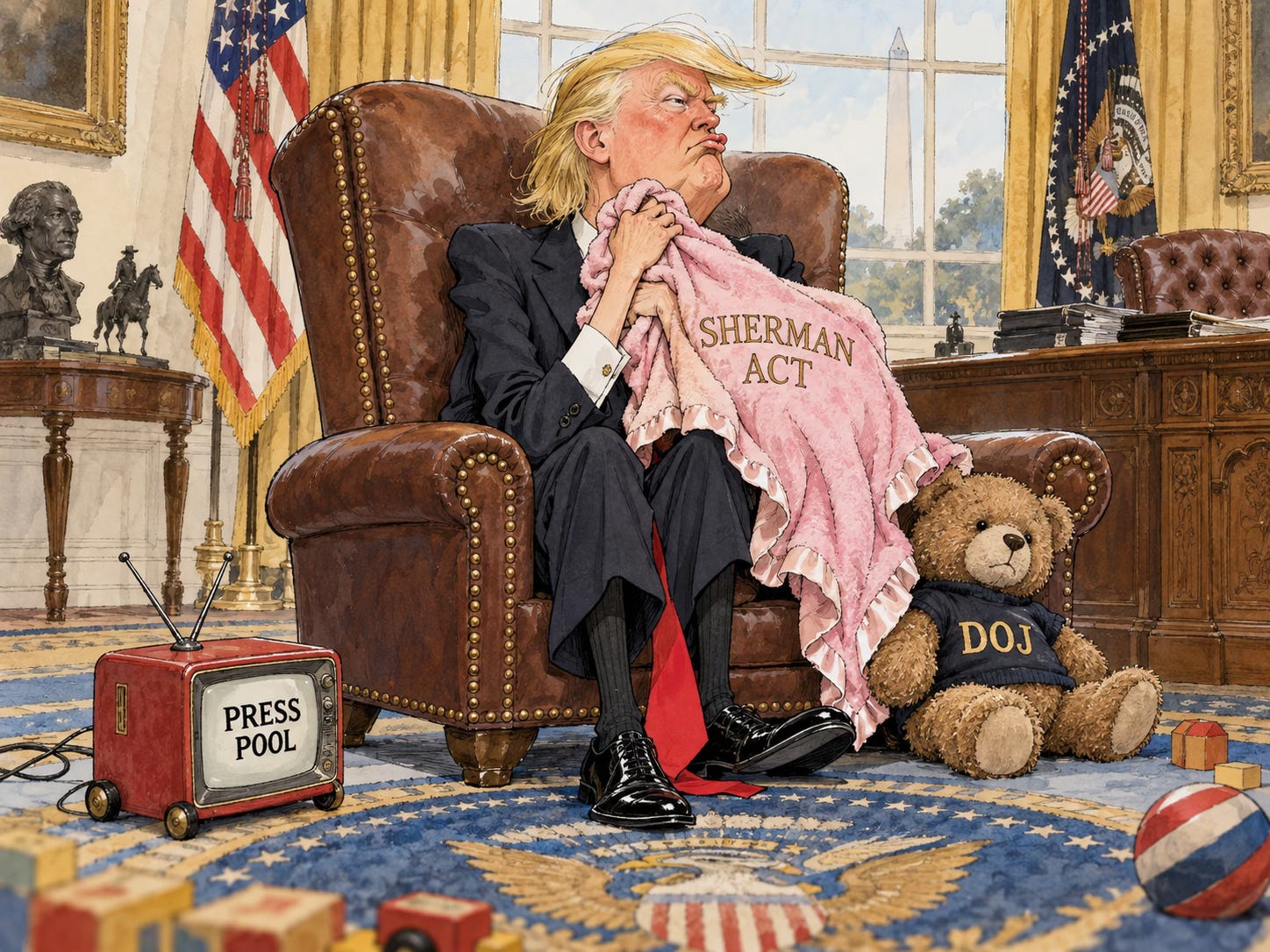
It takes some ingenuity to turn a dispute over White House press credentials into an antitrust investigation. The Trump Justice Department has managed it. ABC, CBS, CNN, NBC, and Fox News are under investigation for possibly violating the Sherman Act because, for four days in September, they suspended the shared television pool that covers the president.
The facts are simple. On September 18, the White House barred CNN, MS NOW, and Politico from its grounds. When the administration then kept CNN from its scheduled pool assignment, the five networks that share pool duty stopped providing the joint feed. They did not stop covering the president; each continued to report on him, and smaller outlets supplied some footage. A federal judge temporarily blocked the ban on September 24. The pool resumed the next day, once the White House approved CNN’s credentials for its turn in the rotation.
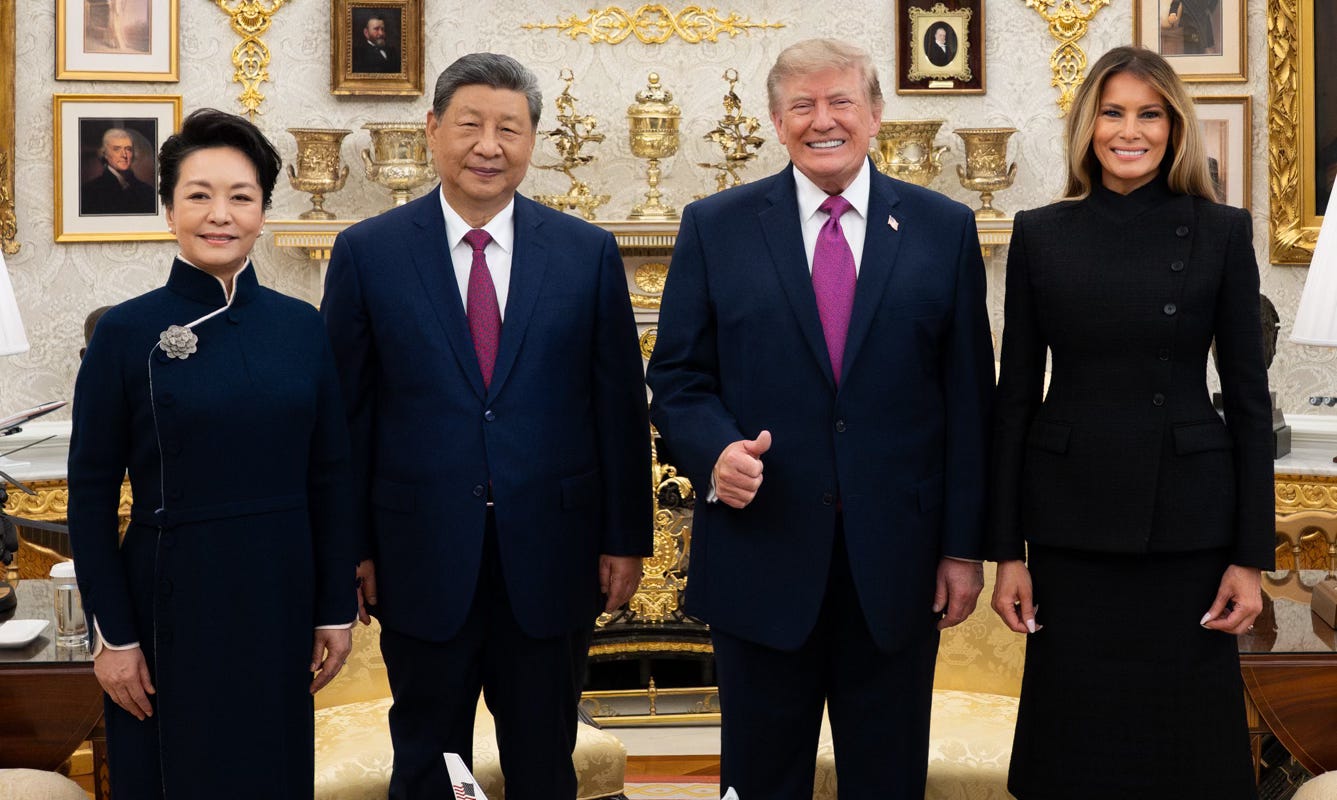
The suspension had a cost: there was no pooled video of President Trump’s meeting with Xi Jinping. And the Justice Department, which sent the networks letters last week requesting their internal communications about pool decisions, has stated its theory. “Group boycotts among commercial competitors can violate the Sherman Act,” said spokeswoman Emily Covington, who added that the networks had “proudly” boycotted.
Group boycotts can violate the Sherman Act. The question is whether this one did.
The Sherman Act prohibits agreements among competitors that unreasonably restrain trade. Price-fixing, market allocation, and certain concerted refusals to deal are the familiar examples. The law does not forbid competitors from agreeing about anything at all, and it does not license the government to investigate every collective act that displeases the president.
The department’s best precedent is FTC v. Superior Court Trial Lawyers Association (1990). Criminal defense lawyers in Washington refused to accept new court appointments until the District raised their fees. They called it political protest. The Supreme Court called it horizontal price-fixing and applied the per se rule, which meant the government did not have to prove the lawyers had market power or that competition actually suffered. It also rejected their First Amendment defense.
This is the networks’ real problem, and it should be faced squarely. Competitors jointly withheld a service, and less pooled coverage of the president resulted. If Trial Lawyers governs, asking the government to identify a competitive injury is beside the point, because the per se rule presumes one.
The objection lands closer to home than that. To reject the market-power requirement, the Court relied on my father. It cited The Antitrust Paradox for the warning that letting small conspirators prove they lacked power would drag market definition into every price-fixing case. He was right, and I do not retreat from it. But his argument was about cartels that fix prices, where the agreement itself reveals what the parties are after. It says nothing about competitors who pause a joint service without touching price.
It does not govern, for two reasons.
The first is that this was not price-fixing. In a footnote, the Trial Lawyers majority stressed that the case involved horizontal price-fixing, not merely a boycott, and acknowledged that some arrangements labeled “group boycotts” may not merit per se condemnation. The boycotts it set aside were nonprice restraints. The networks’ suspension is one. They sought no higher advertising rates, no division of viewers and no exclusion of a rival. They were objecting to the exclusion of a rival.
Their purpose matters for the constitutional question too. The same opinion turned away the lawyers’ First Amendment defense by distinguishing NAACP v. Claiborne Hardware Co. (1982), in which the Court protected a boycott of white merchants in Port Gibson, Mississippi, by Black residents seeking equal treatment. As Trial Lawyers described them, those boycotters sought nothing for themselves; the lawyers sought higher pay. The networks sit on the Claiborne side of that line.
The second is what was suspended. The pool is itself an agreement among competitors: rivals splitting the cost of a camera crew and sharing the footage. Arrangements like that, which make a product possible rather than suppress one, are judged under the rule of reason, as the Court held of blanket music licenses in Broadcast Music v. CBS (1979). A decision by venture partners about when to operate their venture is not a naked restraint. Under the rule of reason, the government must show actual harm to competition. Here the networks kept covering the president individually, other outlets filled gaps, and the interruption lasted four days.
So, what was the competitive injury? Did the networks raise prices to advertisers or carve up viewers? Did their agreement give them power they could use against the public? The Justice Department has not said.
None of this makes the press exempt from antitrust law. Associated Press v. United States (1945) settled that, and fittingly it concerned a news-sharing cooperative whose members used it to shut out competitors. If these networks had fixed advertising rates or excluded rivals, being news organizations would not save them. But a pause in a shared service is not automatically an antitrust offense, and the Sherman Act does not oblige a broadcaster to cover an event because the government thinks the public should see it. When the subject is a collective protest over press access, Claiborne counsels more caution from investigators, not less.
My father spent much of his professional life arguing that antitrust laws should protect competition and consumer welfare, not particular competitors, or unrelated political goals. He distrusted every attempt to make it an instrument for whatever social or political ends happened to be fashionable. Conservatives have spent years making that complaint about progressive enforcers, often correctly. It applies just as much to a Republican Justice Department. We ought to mean it.
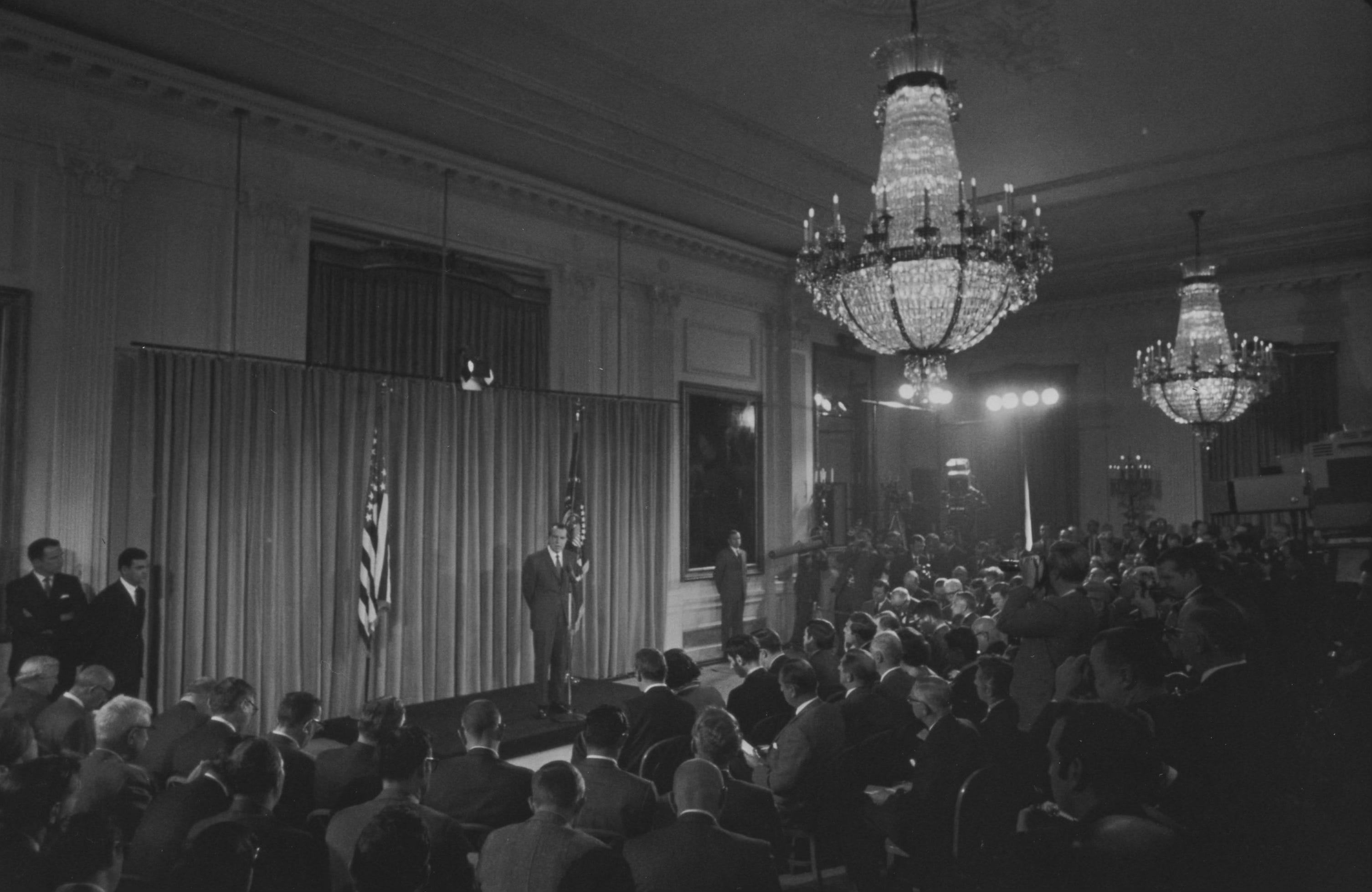
The temptation is not new. In 1971, Richard Nixon was recorded telling an aide that the threat of antitrust action was the best way to keep the networks in line, and his Justice Department sued them the next year. Bruce Brown of the Reporters Committee for Freedom of the Press calls this probe a likely pretext for obtaining the networks’ internal records. Whether that is its purpose remains to be shown. But when no competitive injury has been articulated, the question is hard to avoid.
Perhaps the networks were being self-important. Television executives are not invariably models of judgment, and it would hardly be the first time journalists mistook a quarrel with a president for a historic defense of freedom. None of that makes it an antitrust violation.
President Trump has not suffered from a shortage of television exposure. A president who objects to the networks is free to denounce their coverage, refuse their interviews or deliver another long discourse on the failings of the American press, confident that someone will broadcast it. What he should not expect is an antitrust investigation every time they decline to play along. One can almost imagine the indictment: The defendants, acting in concert and with malice aforethought, deprived the president of the shared camera feed to which he had become accustomed.
If the Antitrust Division has evidence of a genuine restraint on competition, it should produce it. Otherwise, its lawyers have better things to do than referee a schoolyard quarrel over who gets to play with the cameras.