Editor's Note: Jon Nuechterlein is a Washington, D.C.-based attorney and author with broad experience in government and the private sector. He is currently a distinguished scholar at George Washington University’s Competition Law Center, a lecturer at the University of Virginia School of Law and an adjunct professor at Georgetown Law School, where he has taught seminars in antitrust and telecommunications law. We invited Jon to write this article after hearing him speak at the George Mason Law Review 29th Annual Antitrust Symposium hosted by Law and Economics Center.
The Robinson-Patman Act of 1936 is the black sheep in America’s family of antitrust laws. The Sherman Act of 1890 and the original Clayton Act of 1914 have long been read to promote efficient competition, not to protect small firms from the rigors of competition. But the RPA has always been different. Its convoluted text seems to require protecting the profit margins of small retailers even at the risk of raising consumer prices. Fifty years ago, the federal antitrust agencies soured on that project and gradually stopped enforcing the RPA.
Those days of considered neglect are now over. The RPA has regained a surprising degree of bipartisan support (see here, here, and here), and the FTC is actively litigating its first RPA case in decades. What explains the new enthusiasm for this Depression-era statute, and what are the consequences for consumers?
Some history
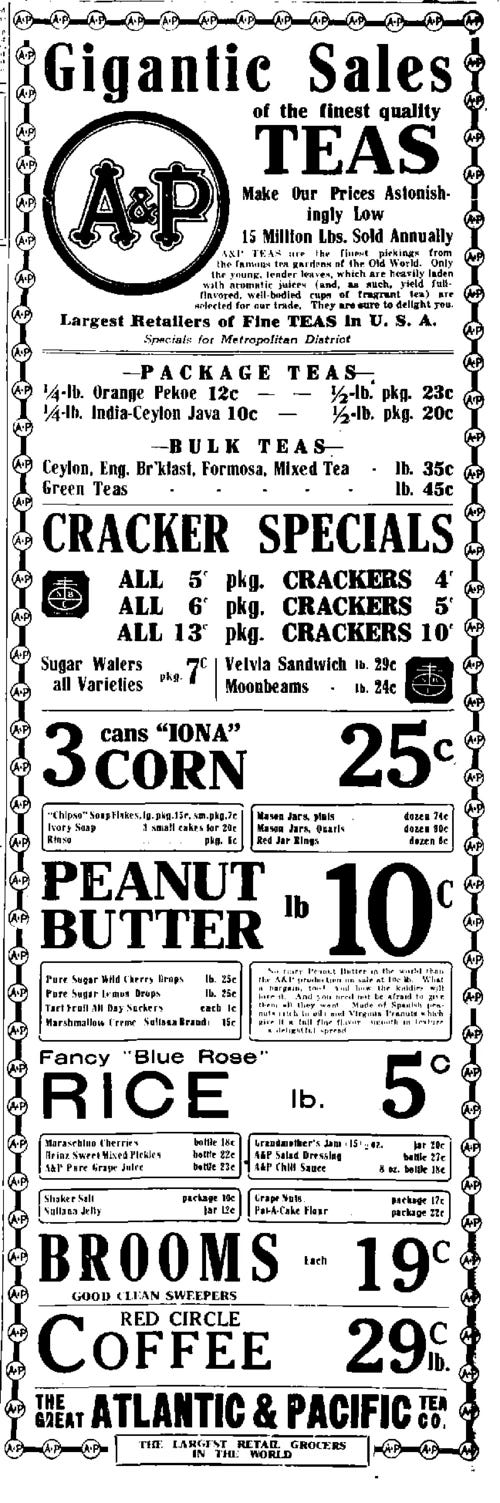
Let’s go back to the beginning—to the economic history that originally motivated this legislation. A hundred years ago, a single company’s business plan radically disrupted the U.S. retail sector and created important political enemies along the way. That company was a vertically integrated supermarket chain named A&P, which eclipsed traditional grocery stores and rapidly became America’s largest retailer by far.
How did A&P do it? Because of its scale, A&P negotiated lower wholesale prices from food producers than smaller grocers could bargain for. And A&P had vertically integrated into warehousing and distribution, so it could avoid paying the traditional wholesale middlemen who served the smaller grocers. A&P passed these upstream savings on to consumers in the form of lower retail prices that corner grocers could not match. This benefited consumers but harmed the corner grocers and the independent wholesalers who served them.
The RPA was enacted in large measure to curb A&P’s successful business model and—no surprise—was originally entitled “the Wholesale Grocer’s Protection Act.” Let’s quickly review the RPA’s working parts as they relate to so-called “secondary-line” price discrimination.
In general, the Act forbids suppliers to sell “commodities of like grade and quality” at different prices to different purchasers if doing so gives one purchaser a competitive advantage over another. But that general prohibition on price discrimination comes with a variety of qualifications and defenses that have spawned 90 years of interpretive controversies.
First, the Act applies only to sales of tangible products, not to services, and only if the goods qualify as “interstate” in the sense that they can be said to cross state lines. That requirement has given rise to all sorts of disputes about (for example) how to treat goods that are manufactured in one state, shipped to a warehouse in another state, and only then sold to the latter state’s purchasers.
Second, a supplier that provides special discounts to a given purchaser can escape liability if it proves that it acted in good faith “to meet an equally low price” of a competing supplier. But this affirmative defense permits the supplier only to meet, not to beat, the lower price. It also requires defendants to substantiate their prior knowledge about their own competitors’ prices. That requirement in turn creates perverse incentives for the relevant actors to share otherwise non-public price information, with the potentially anticompetitive effect of stabilizing prices.
Another affirmative defense enables a supplier to escape liability if it proves that its price differences mirror “differences in the cost of manufacture, sale, or delivery” of the relevant goods. In practice, this is a difficult defense to substantiate. Litigation on the issue, in the words of one Yale professor in 1937, “proceeds by the ordeal of cost accountancy,” with opposing experts arguing about such economically intractable issues as the proper way to allocate joint and common costs across different transactions.
Now let’s return to the Act’s core ban on wholesale price differences and the immediate effects on A&P and other chain stores. Before 1936, A&P could bargain aggressively with farmers for company-specific discounts on (say) eggs and pass the savings through to its retail customers. But after 1936, a farmer had to charge A&P the same price per egg that it charged smaller grocers or their wholesale suppliers. This requirement plainly benefited small grocers and wholesalers at the expense of A&P. But what was the likely result for consumers then and today? In the aggregate, does the RPA’s qualified ban on price discrimination raise the wholesale prices charged to grocery stores and ultimately the retail prices charged to consumers?
The consumer effects of restricting wholesale price discrimination.
The answer to that consumer-welfare question is complex and market-dependent (see here, here, and here). As the RPA’s defenders explain, it is too facile to argue that RPA enforcement always leads to higher retail prices. Banning price discrimination does not necessarily cause a supplier to raise wholesale prices for all buyers, including the most powerful ones, to the highest level that the supplier would otherwise charge the smallest buyer with the least bargaining clout. Instead, the new wholesale price equilibrium might well fall somewhere between the highest and lowest wholesale prices that would be charged but for the ban on price discrimination.
Consider the newly uniform wholesale price of eggs after 1936 in our A&P hypothetical. Depending on competitive dynamics, that price might well have been (1) lower than what the smallest grocer would have paid absent the RPA but (2) higher—and perhaps much higher—than the much lower wholesale price that A&P previously negotiated. That outcome would have been a mixed bag for consumers. On the margins, a significant shift in wholesale costs would have enabled small grocers to lower their retail prices while forcing A&P to raise its own retail prices. And the most price-sensitive retail consumers—those with tightest budgets who came to A&P looking for the best bargains—likely paid more for their eggs, all else held equal.
What was true in 1936 remains true today. The RPA likely has similarly regressive effects on low-income households, at least in some contexts. And the statute’s qualified ban on price discrimination might also cause more systemic competitive harms. For example, by mandating wholesale price uniformity, the RPA makes coordination easier and retail prices stickier by increasing each market actor’s visibility into other market actors’ pricing practices.
Much of the recent discussion about the RPA’s competitive effects involves a debate about the so-called “waterbed effect” modeled by some economists and championed by Republican FTC Commissioner Mark Meador. The theory proceeds as follows. Because upstream price discrimination reduces a larger retailer’s wholesale costs and permits it to undersell a smaller retailer, it can lessen the smaller retailer’s market share and thereby reduce the smaller retailer’s bargaining clout with their common supplier. In a worst-case scenario, the feedback loop may lead the smaller retailer to exit the market. And the RPA’s defenders argue that, in some contexts, this effect might result not only in hobbled competitors, but also in higher average retail prices.

That outcome, however, is likely the exception rather than the rule. Even where price discrimination ends up marginalizing small retailers, competition among large retailers (e.g., Walmart, Target, and Costco) normally induces each such retailer to pass some and perhaps most of its wholesale discounts through to consumers, depending on the extent of the downstream competition. And the waterbed effect should have no effect at all on smaller retailers (such as general stores in remote rural areas) that do not compete with large retailers in the first place. By hypothesis, their market share is unaffected by the large retailers’ competitive offerings, and thus their bargaining power with suppliers is unaffected by whatever discounts those larger retailers receive.
The decline, fall, and sudden rebirth of federal RPA enforcement.
“Populists on both the right and the left view Robinson-Patman litigation as an important weapon in the fight against what they perceive as excessive market concentration.”
In short, even if the RPA does occasionally have consumer benefits, such benefits are episodic and incidental to the protectionist objectives of the Act. And they are probably more than offset in the aggregate by the Act’s upward retail pricing pressure in other markets.
That, in any event, was the conclusion of an influential 319-page report issued by the Department of Justice in 1977. DOJ placed the Act squarely in its historical context. As it observed, “the Robinson-Patman Act is a piece of depression-era legislation” and resembled the National Industrial Recovery Act, which sought to boost employment by eliminating cut-throat competition and stabilizing prices at inflated levels. DOJ’s report concluded that Robinson-Patman likewise served in many markets to raise consumer prices. DOJ also compared the Act to the Nixon Administration’s then-recent experiment with wage and price controls, noting that “government tampering with the market can lead to unforeseen results which have an adverse effect on workers, businesses, and the consuming public.”
DOJ’s 1977 report was hardly the first comprehensive critique of the Robinson-Patman Act, but it crystallized widespread opposition to the Act in antitrust circles, and the results were immediate and striking. DOJ stopped enforcing the Act altogether. The FTC, which had brought thousands of RPA claims in the 1960s and 1970s, followed suit shortly thereafter. Of course, non-enforcement by the federal government did not mean that the Act itself fell into complete disuse. But it did shift the burden of RPA enforcement to the private plaintiff’s bar, which lacks the federal government’s powers of pre-litigation discovery.
But here’s the breaking news: the federal enforcers have put on their cleats and want back in the game. Lina Khan’s FTC brought two high-profile Robinson-Patman cases towards the end of the Biden administration, and one of them remains alive and kicking with no end in sight. And earlier this year, six Republican Senators publicly urged both the FTC and DOJ to bring more Robinson-Patman cases to support the interests of various business constituencies.
This is unsurprising. Populists on both the right and the left view Robinson-Patman litigation as an important weapon in the fight against what they perceive as excessive market concentration. And when push comes to shove, they are willing to ban price discrimination to prop up small businesses even if doing so harms consumers.
This makes sense as a purely political matter because the resulting consumer harms are more diffuse and obscure than the benefits to small businesses. The constituencies that support aggressive RPA enforcement can realistically hope for reduced competitive pressure and wider profit margins. In contrast, consumers are very unlikely to connect downstream price hikes with an uptick in RPA enforcement and are thus unlikely to pin political blame on the RPA’s champions.
To be sure, this is a ham-fisted way to help Main Street. Even if one believes that the government should support small retailers to preserve their perceived value to local communities, there are more efficient and consumer-friendly means to that end, ranging from tax credits to small-business loans. Nonetheless, the RPA remains the law and says what it says, and enforcers have taken a new shine to it.
* * *
For many years as an antitrust lawyer, I hoped to get away with learning very little about the Robinson-Patman Act. After all, DOJ and the FTC had soured on the RPA and stopped enforcing it. Why should I have to learn the arcane details of this benighted statute?
Alas, as with so much else in antitrust, everything old is cool again. The Robinson-Patman Act is badly drafted, byzantine in its application, and at odds with the consumer-oriented thrust of America’s antitrust laws. But if you’re an antitrust lawyer, you’d better bone up on the doctrinal details because federal RPA enforcers are back in the saddle.