


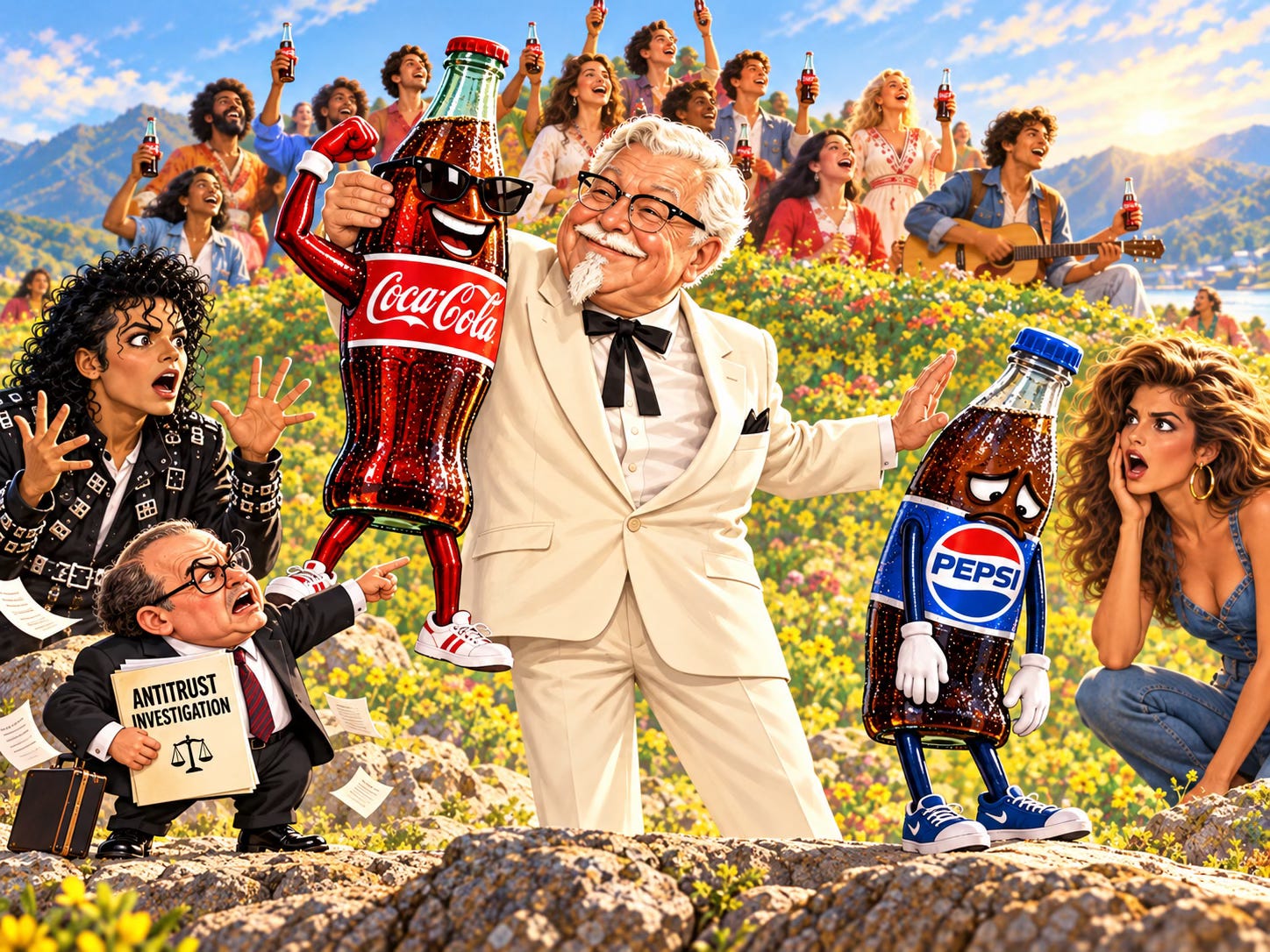
Coca-Cola is trouncing Pepsi. Its market share is more than twice that of its longtime rival, and now Kentucky Fried Chicken is dumping Pepsi after a forty-year relationship. Somewhere in Washington, an ambitious antitrust lawyer must be wondering whether Coke has monopolized fried chicken.
After all, in some antitrust circles, winning is practically a confession of guilt.
Pepsi once advertised itself as “The Choice of a New Generation.” Evidently, the Colonel has decided it’s time for a new generation of soft drinks, too. And Coke, which once promised to teach the world to sing in perfect harmony, has persuaded KFC to change its tune.
Behind the advertising nostalgia is a serious lesson about competition and the consumer welfare standard. The purpose of competition is not to guarantee that everybody wins. It is to make companies compete for the privilege of serving consumers. Market share is the result of that contest, not a prize the government is supposed to distribute.
As Phil Wahba reports in Fortune, the cola wars haven’t been particularly close lately.
In the 1980s and 1990s, Pepsi and Coke were nearly neck and neck. Pepsi challenged Americans to blind taste tests, enlisted Michael Jackson to sell its brand to a new generation, and gave Cindy Crawford a starring role in one of the most memorable commercials of the 1990s. Coke countered with “It’s the Real Thing,” “Have a Coke and a Smile,” and that unforgettable hillside chorus singing about harmony.
Today, Coca-Cola commands 18.5 percent of the American carbonated soft-drink market, compared with Pepsi’s 8.1 percent. Even Dr Pepper has passed Pepsi. Whatever happened to the Pepsi Generation?
