


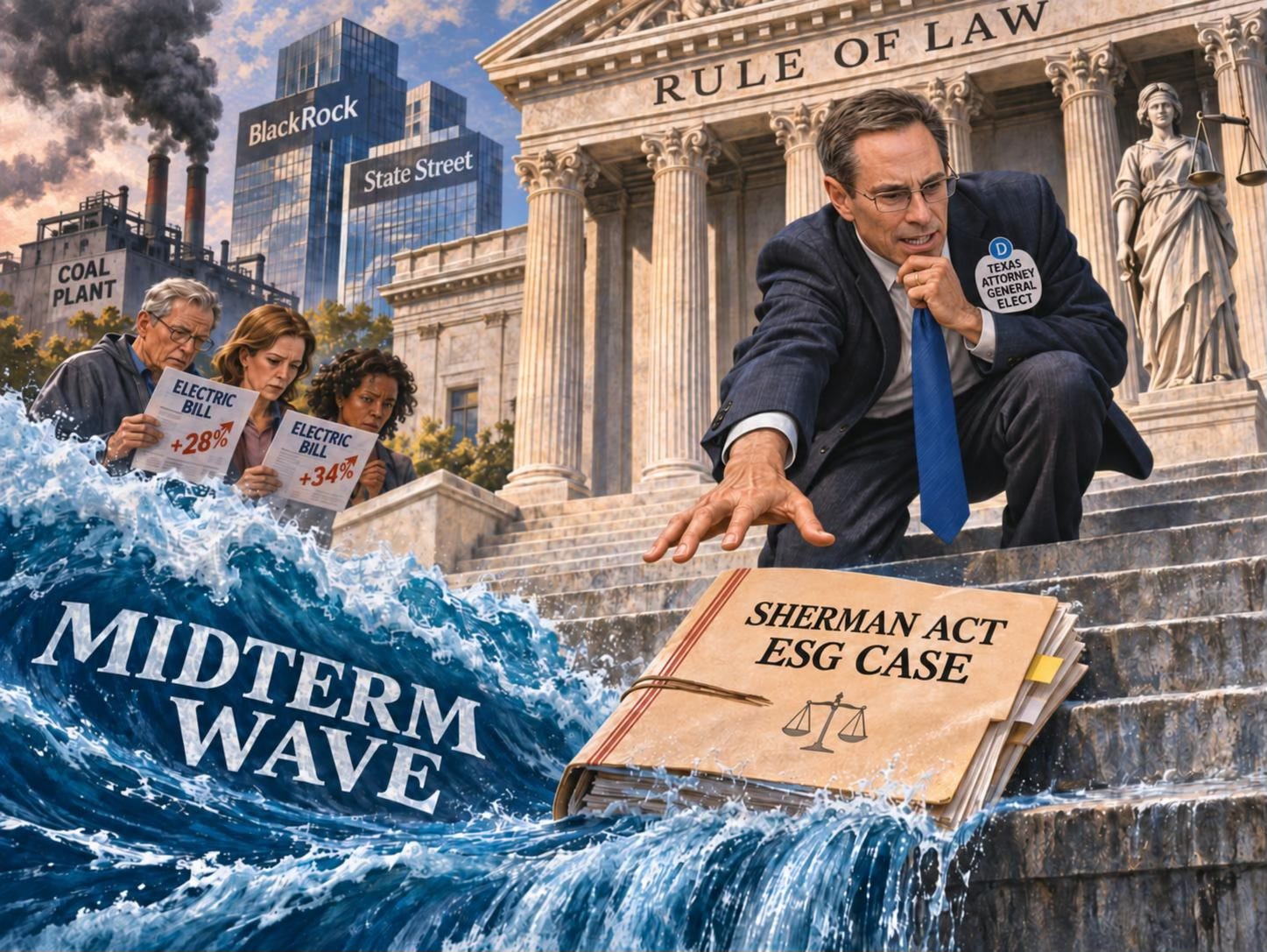
Democrats have spent years warning that corporate giants are conspiring against American consumers. Now, thanks to their midterm victories, they have an opportunity to prove they mean it. Or to demonstrate that collusion is objectionable only when the alleged conspirators support the wrong political causes.
The election of Democratic attorneys general in Texas, Iowa, and other states threatens to derail a major antitrust lawsuit accusing BlackRock and State Street of coordinating efforts to restrict American coal production and drive up energy prices. The defendants deny the allegations, but the case has survived substantial legal challenges, and a federal judge has found sufficient evidence of a possible conspiracy to allow the litigation to proceed.
The irony is considerable. Some of the world’s largest financial institutions stand accused of precisely the sort of anticompetitive behavior that progressive politicians claim to abhor. Yet the defendants’ commitment to environmental, social, and governance (ESG) objectives may provide them with a political escape hatch.
The question is not whether ESG is good or bad. It is whether powerful institutional investors conspired to replace independent business decisions with coordinated restrictions on production. If they did, their environmental ambitions provide no defense. An antitrust conspiracy does not become lawful because its participants believe they are saving the planet.