


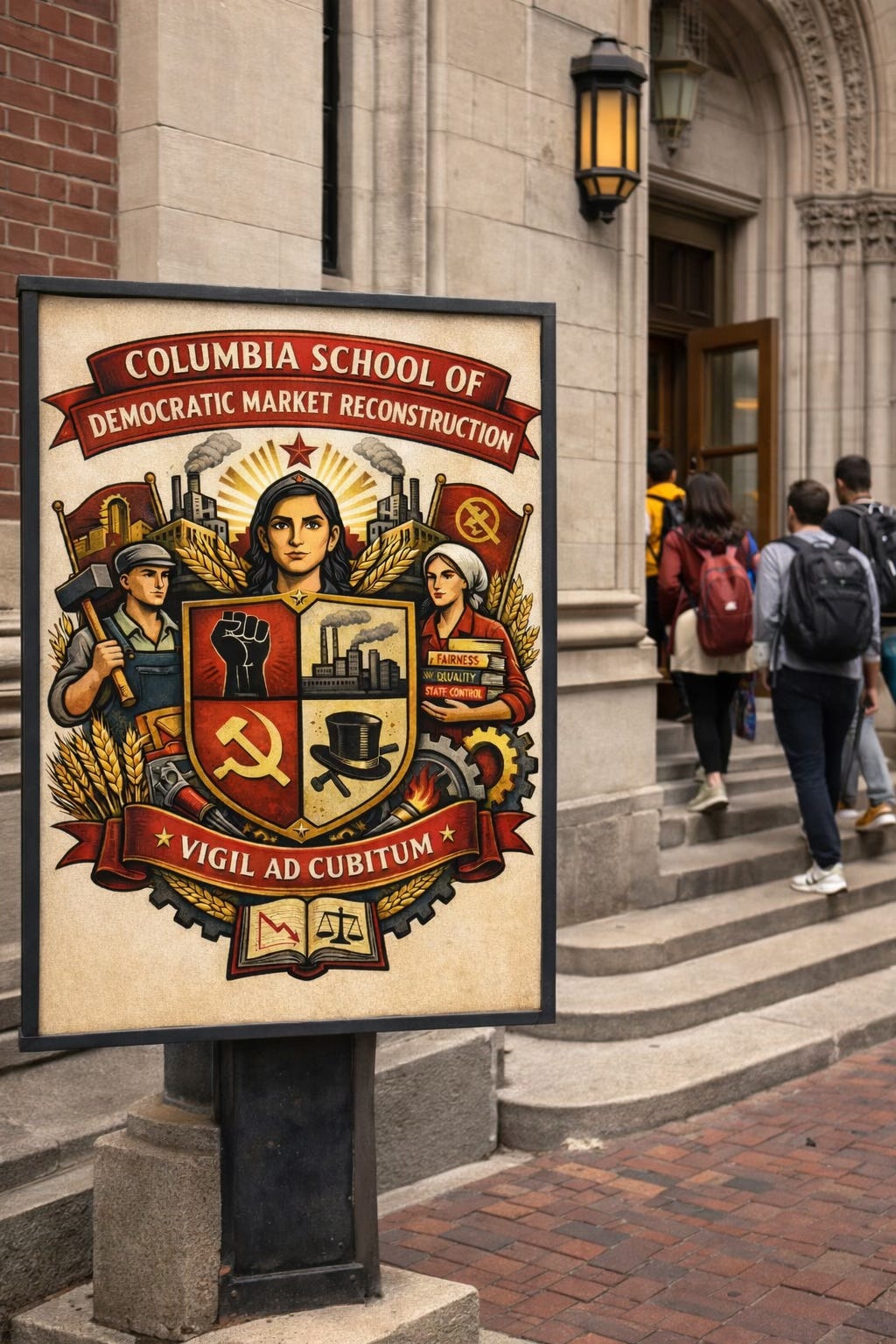
The news that Columbia University Law School is establishing a new Center for Law and the Economy – to be directed by Biden’s former FTC Chair Lina Khan and includes former Biden economic and legal advisor, Tim Wu – is a new and exciting development in the future of American antitrust enforcement.
The creation of the center, Khan says, responds to “tremendous interest from law students, and the center will help harness that interest and develop the scholarship and expertise needed to advance this work across key areas of economic law and policy.”
To help guide this new center, below is a suggested curriculum to shape the legal philosophy of Columbia Law students – the Lina Khans and Tim Wus of our future.
Structural Inequality Studies: Econ 501 – Why Markets Fail (Especially When They Work)
Many law students arrive clinging to naïve and outdated concepts of the market as “free” – believing that market dominance is usually challenged and corrected by a mythical deity called the Invisible Hand. This course demonstrates how innovation and consumer surplus mask deeper harms such as scale and excessive efficiency, while exploring the corrosive effect of discounting and low prices in promoting inflation.
Econ. 502 – “Small Dealers and Worthy Men”
First, an apology for the title, which harks back to the archaic (and frankly nebulous) word “men.” Yet it derives from a foundational Supreme Court opinion from the late 19th century that presaged the Center’s Brandeisian ethos. This course will explore why a big company’s size is a marker of late-stage capitalism practically begging for the regulator’s wrecking ball.
Econ. 503 – Taking a Razor to the Rule of Reason
This course explodes the myth of neutral principle in regulatory enforcement. As progressive expert Matthew Stoller put it, “the point of economics as a discipline is to create a language and a methodology for governing that hides political assumptions from the public.” The rest is just math.
Antitrust Redistribution: Law 510 – The Fascistic Roots of the Consumer Welfare Standard
Students learn to move beyond price effects toward a holistic and critical evaluation of how the current antitrust dogma upheld by federal judges of both the left and the right serves unequal power arrangements under the guise of “consumer welfare.” We will explore how antitrust enforcement can look beyond price, innovation, and choice for consumers to become a strategy to promote unions, inefficient competitors, and – in the words of Rebecca Kelly Slaughter – confront “structural and systemic racism that underlies and facilitates acts of violence.”
Law 511 – Antitrust Without Apologies
How to bring cases first and define the theory later – such as the failed FTC case against the Meta monopoly, while ignoring the fierce competition Meta faces from YouTube, TikTok, iMessage, Mastodon, LinkedIn, as well as growing personal networks such as WeChat, Telegram, Snapchat, Reddit, Pinterest, Discord, and Tumblr.
Law 512 – Gerrymandering Antitrust Cases
We learn how to sue anyone as a monopolist by defining markets as narrowly as possible. A case study: How the FTC under our Director Khan investigated Subway as a “Big Sandwich” monopolist by excluding markets for warm beef and chicken sandwiches, while otherwise including anyone who could slap something between two pieces of bread. Students will develop mock cases of their own, such as suing Chick-fil-A for monopolizing the market for chicken sandwiches not sold on Sundays.
Law 513 – Vertical Integration as Original Sin
We learn why owning multiple stages of production is presumptively suspect, especially when heartless efficiency is maximized.
Law 514 – The Heroic Return of the Robinson-Patman Act
How the future regulator can ensure that no firm ever gets too good at winning market share by economies of scale and discounting for consumers. Case study: How the “Walmart Effect” ruined the American economy by delivering “Everyday Low Prices.”
Administrative Omniscience: Law 515 – Monopsony Everywhere
How to develop the techniques for finding the victimization of labor markets in any dataset and convert competition law into a parallel labor code.
Law 516 – The Policemen at the Elbows
Explore the social value created by unrelenting oversight and static rules on dynamic markets. We will develop advanced mental techniques by which antitrust experts can foresee future market developments that elude the brightest people in investment capital.
Econ Colloquium: Industrial Policy for Beginners
How to use political favoritism and heavy-handed capital allocation under the rubric of “planning.” We will also study how subjecting capital and business to the whim of politically controlled regulators will one day lead to the “withering away” of the state.
Capstone Project – Designing Markets that Behave
Students re-engineer industries so outcomes align with preferred social distributions – avoiding demerits for any policies that promote efficiency. Students must always keep faith with the Center’s motto: Vigil ad cubitum (“The policeman at the elbows”).
Robert H. Bork Jr. is president of the Antitrust Education Project.