

By Rick Amato
Perhaps the word “liberal” needs to be retired. Its worn plasticity is reason enough to render it shapeless and meaningless. Could the same also be said of the word “conservative”?
“Liberal” denoted classical free-market economics, ranging from Adam Smith’s invisible hand, only lightly restrained by regulation, to the hands-off approach of laissez-faire libertarianism. In the New Deal era, it came to mean government-directed capitalism and Keynesian stimulus. Now it is largely derived to describe people who are not liberal in any sense but veer toward Marxist-inflected statism in politics and economics.
But the “conservative” alternative is also increasingly indistinguishable from the “liberal” one.
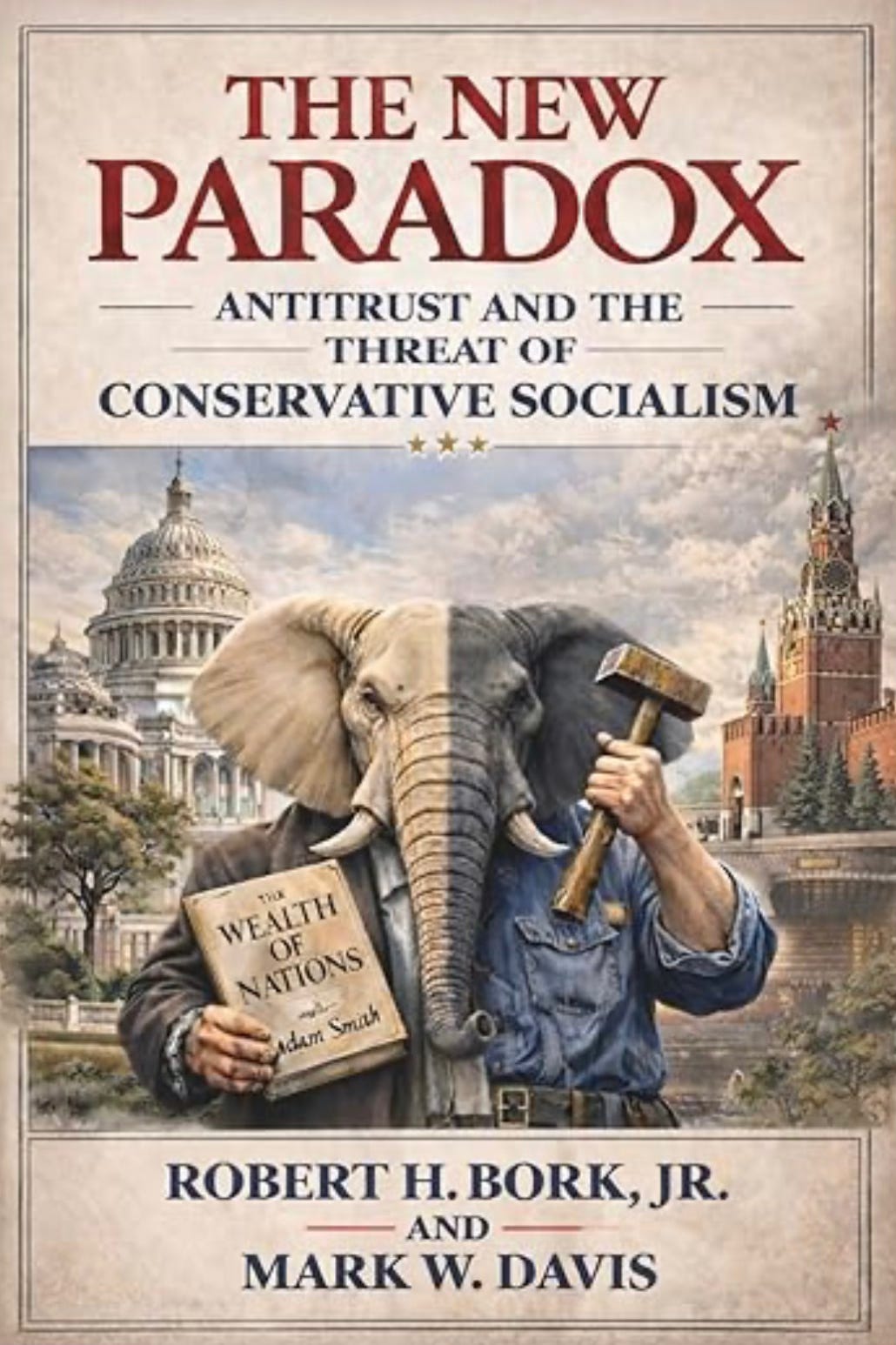
This is the abiding concern of The New Paradox: Antitrust and Conservative Socialism, in which Robert H. Bork Jr. and Mark W. Davis attempt something as provocative as it is ambitious. They defend the classical liberal foundations of American antitrust law not just against the progressive Left, but also against an emergent strain on the Trumpian Right. Their central claim is as counterintuitive as their title suggests: that parts of the modern conservative movement are drifting toward what they call “conservative socialism,” using the tools of antitrust not to protect competition but to punish disfavored firms for political ends and bring business under the thumb of regulators, what Biden’s progressive enforcer Tim Wu calls “the policeman at the elbow.”
The book’s title is a play on The Antitrust Paradox, the foundational work by one of the author’s father—Robert Bork, jurist and legal scholar—who famously reoriented antitrust doctrine around the consumer welfare standard. Bork argued that the purpose of antitrust law is to promote efficiency, which protects the welfare of consumers, not lesser competitive firms seeking to shield themselves from competition.
Bork Jr. and Davis argue this consensus—adopted by the US Supreme Court in 1979, one year after the book’s publication—is now under threat from two political directions. The threat from the left is the firebrand progressive antitrust movement, championed by Biden’s Federal Trade Commission Chair Lina Khan. The other threat is a surprise, the often-overlooked radicalism of the “Khanservative” imitators of Khan within the new Right, self-described conservatives who have continued the statist, government-central merger guidelines of the Khan era without changing a dot or tittle. The authors warn that both antitrust movements are addicted to power, sharing a willingness to weaponize antitrust for political or cultural objectives rather than economic ones that would benefit consumers.
The authors contend that feigned outrage at “Big Tech” has led Khanservatives to embrace expansive antitrust enforcement out of pique against censorship of speech. Bork and Davis frankly admit that large social media platforms did censor, deplatform, and shadowban conservative speech during the Biden administration. But they argue that this censorship was largely driven by secret programs of the Biden White House, which dispatched 80 FBI agents to intimidate Meta and other highly regulated companies into censoring conservative speech.
While conservatives have every reason to be sore, Bork and Davis argue that Khanservatives overcorrect, continuing the antitrust suits and progressive legal theories of Lina Khan out of sheer pique and political animus. While Big Tech is the favored target of both Khan and the Ferguson-Meador team, the rules being cemented in place by regulators of both parties is turning antitrust into a form of industrial policy, precisely what earlier generations of conservatives rejected.
Worse, Ferguson and Federal Communications Commission Chairman Brendan Carr are taking government intervention to an extreme that even Lina Khan did not dare. They are weaponizing the government’s merger authority in an attempt to control speech and journalism. Example: Carr threatened to derail Paramount Global’s merger with Skydance Media if CBS News, owned by Paramount, did not settle President Trump’s lawsuit over how it edited an interview with then-Vice President Kamala Harris. This was a nuisance lawsuit, asserting an injury over the editorial judgment of a news organization. In the hands of Carr, however, it was a live threat to a major business deal. As soon as Carr’s tactic extracted $16 million from CBS, Carr suddenly dropped any objections to the merger.
For his part, Andrew Ferguson is pioneering the use of “terms and conditions” of news apps like Apple News to assert a right to enforce what he considers more balanced coverage. Carr recently followed up by threatening to pull the broadcast licenses of network affiliates if they don’t provide more balance in their coverage of the Iran War.
Bork and Davis write:
It is understandable why conservatives savor the schadenfreude of CBS’s discomfort, a network that frequently vilifies the right; or want to discomfort Apple News, which doesn’t include posts from Breitbart or National Review. But make no mistake—this is a base act of state censorship, an abandonment of principle and the Constitution. In this way, conservatives used government antitrust power to force a government-mandated “fact check” of a news organization and intimidate its corporate owner for speech. This is not only unprincipled. It is also supremely stupid. If Carr and Ferguson succeed in pioneering new ways to use regulatory power as a threat to punish speech, they will have created a regulatory power certain to be used against conservative media and organizations by the next progressive administration.
“What he [Carr] said there is dangerous as hell,” Sen. Ted Cruz said, comparing the attraction of the power to censor opponents to the evil temptation of the ring in Lord of the Rings. “Going down this road, there will come a time when a Democrat wins again, wins the White House . . . they will silence us.”
Bork and Davis follow up on this warning:
Imagine if Lina Khan returns to the FTC chairmanship under the next Democratic president. Could she similarly threaten the nonprofit Media Research Center—the conservative watchdog of mainstream media foibles that spotted Apple News’ biases—with being ‘deceptive’ because it has a given slant? Could she drag Fox News, Newsmax, Breitbart, and National Review through costly investigations for ‘violating reasonable consumer expectations’ for not reporting the approved line on climate change? Could the next progressive to chair the FCC use regulatory authority to extract payments for editorial decisions in how they cover Democrats?
Bork and Davis conclude that this unprecedented enablement of government power over speech and journalism is not just unprincipled but “ideological suicide.”
This willingness of Bork and Davis to critique the Right from within gives it intellectual bite. The authors consistently return to their core ideas—that consumer welfare should be the lodestar of antitrust and that true conservatives should return to the rule of law and institutional restraint.
The New Paradox is a sharp, necessary critique of a new Right that is ceasing to be on the Right. The real danger to antitrust, they argue, is not overenforcement or underenforcement but the loss of principle itself.
* * *
Rick Amato is a former financial adviser for Merrill Lynch and founded the Amato Wealth Management Group. He hosts Politics and Profits with Rick Amato.
This review was first published in American Greatness.