


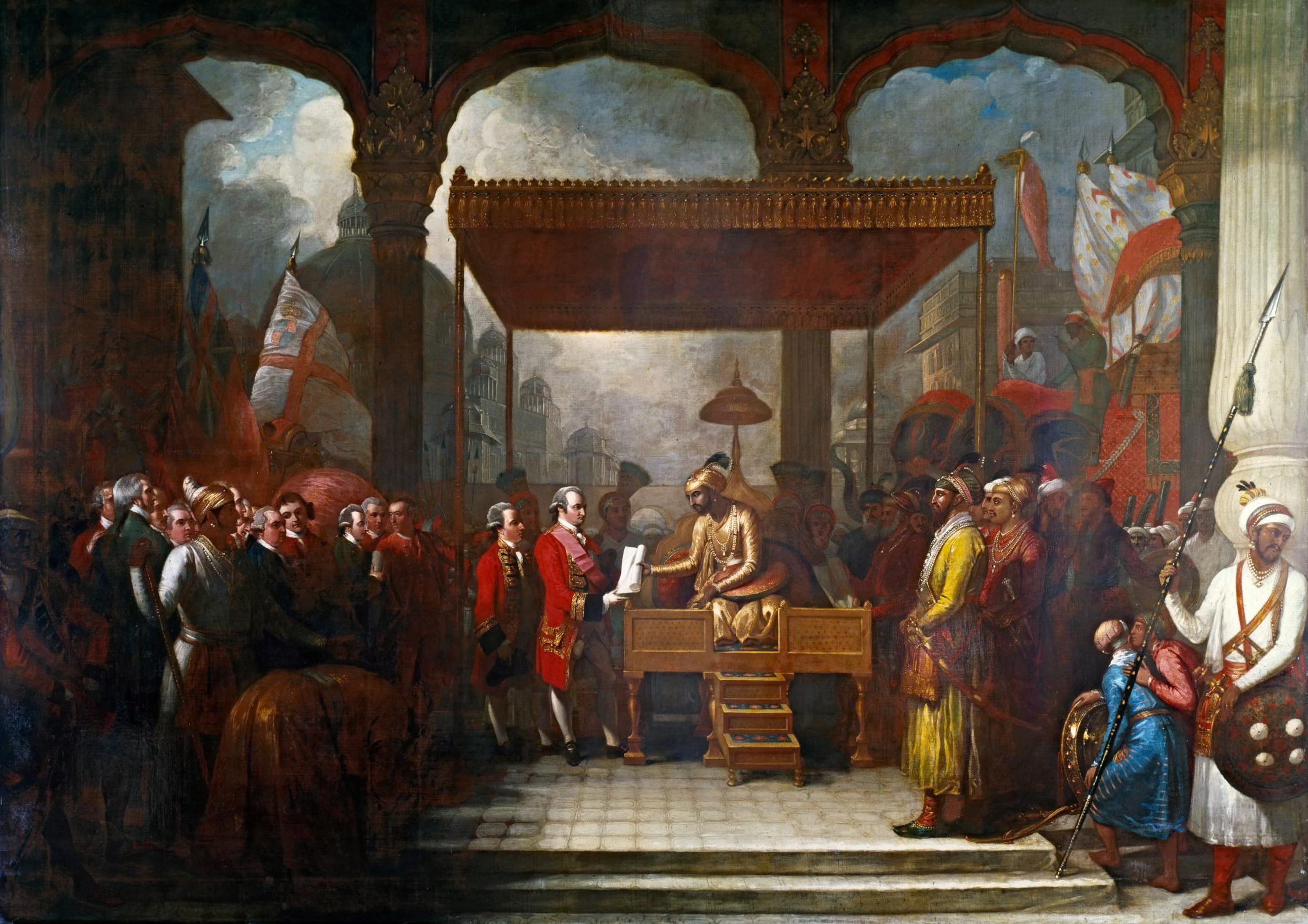
Scottish historian, writer, and podcaster William Dalrymple’s essay in The New York Times compares today’s American tech giants to the East India Company, the joint-stock company that conquered and exploited Mughal India, grew opium in Bengal, and sold it to millions of addicts in China.
“Here, as in so much of imperial history, commerce, colonization and brute corporate power walked in lock step,” Dalrymple writes. He quotes Tolstoy’s letter to Gandhi in which the novelist marveled that “a commercial company enslaved a nation comprising 200 million people.”
Dalrymple’s essay is colorful and engaging, but his comparison between the East India Company and America’s tech titans is strained—leading, not surprisingly, to the conclusion that more government control of Big Tech is needed. He makes the case that the U.S. government should crack “the whip hand” to humble these companies, just as the British government ultimately did when it nationalized the East India Company after its incompetence fueled the Indian Rebellion (“the Great Mutiny”) in 1857.
“Big Tech has, too, begun to take on the attributes of sovereign states, and in many ways is now as powerful as the East India Company at its height,” Dalrymple writes.
He points to Nvidia’s valuation of more than $5 trillion, “roughly the gross domestic product of Germany, the world’s third-largest economy, with a population of 84 million.” He enumerates the eye-popping valuations of Apple and Alphabet, and the growth of SpaceX’s share of all satellite launches from below 10 percent in 2014 to around three-quarters last year—all as evidence that Big Tech is dominated by rogue companies in need of humbling.
But stock valuations are far more volatile and ephemeral than a country’s GDP. And, unlike the East India Company, which enriched a slice of British elites, the wealth that today’s tech leaders generate enriches the portfolios of tens of millions of mom-and-pop investors and retirees around the world.
Dalrymple acknowledges that Nvidia and its peers have no standing armies or conquered territory. That is no small distinction. There are other significant differences. The East India Company was granted a royal charter in 1600, giving it trading rights across a vast quadrant of the Earth. It acquired armies, conquered territory, and governed hundreds of millions of people. It sold many things—indigo dye, silk, sugar, opium—but it was essentially an exploiter of human labor and other people’s land.
Nvidia did not arise from a royal charter issued by a mercantilist power. It emerged from a meeting between three young engineers at a Denny’s. Nvidia now dominates the upper end of AI chips, but it is not a monopoly. It is engaged in fierce competition with global leaders like AMD, Intel, Google, AWS, and others. It is true that SpaceX has close to a monopoly in heavy-lift launches – partly due to the failure of Boeing and other traditional contractors. But would the U.S. economy and national security be improved if SpaceX were broken up into several separate launch companies? The little SpaceXs might compete on price, but the economies of scale—and likely the competence—needed for this monumental enterprise would be lost.
Google does have a monopoly on search, but this is not the result of a modern version of a royal charter, either. It is simply a function of network effects—everyone uses Google because everyone uses Google.
And besides, who wants to be forced to navigate between 10 Googles?
As for the raw political power of Big Tech, it has not kept Meta from being forced into a recent settlement worth up to $17 billion with a coalition of dozens of state attorneys general. And as for the power of Big Tech donations, remember that Elon Musk and Musk-backed groups invested $30 million in support of a candidate for the Wisconsin Supreme Court—and lost.
If Dalrymple’s diagnosis is iffy, his prescriptions are troubling.
He seems to be pointing to China as a model of how a powerful state can humble “corporate kings.” He approvingly describes Chinese dictator Xi Jinping’s humiliation of Jack Ma, co-founder of Alibaba, for the crime of publicly complaining about heavy-handed regulation. The planned IPO of Ma’s Ant Group was canceled, and the company was then forcibly restructured. Dalrymple writes that Ma “largely disappeared from public life in China, resurfacing in February 2025 to shake Mr. Xi’s hand at a televised symposium of chastened entrepreneurs.”
On a gentler scale, something similar happened at Donald Trump’s second inaugural, when tech CEOs, intimidated by the president’s promised retribution, lined up to kiss the king’s ring.
Whether in China or in Trump’s America, the humbling of corporations by the state is not a recipe for broader economic growth or a stronger democracy. It is, as China is learning and America may soon learn, the path to crony capitalism, which makes us all poorer and less free.
