



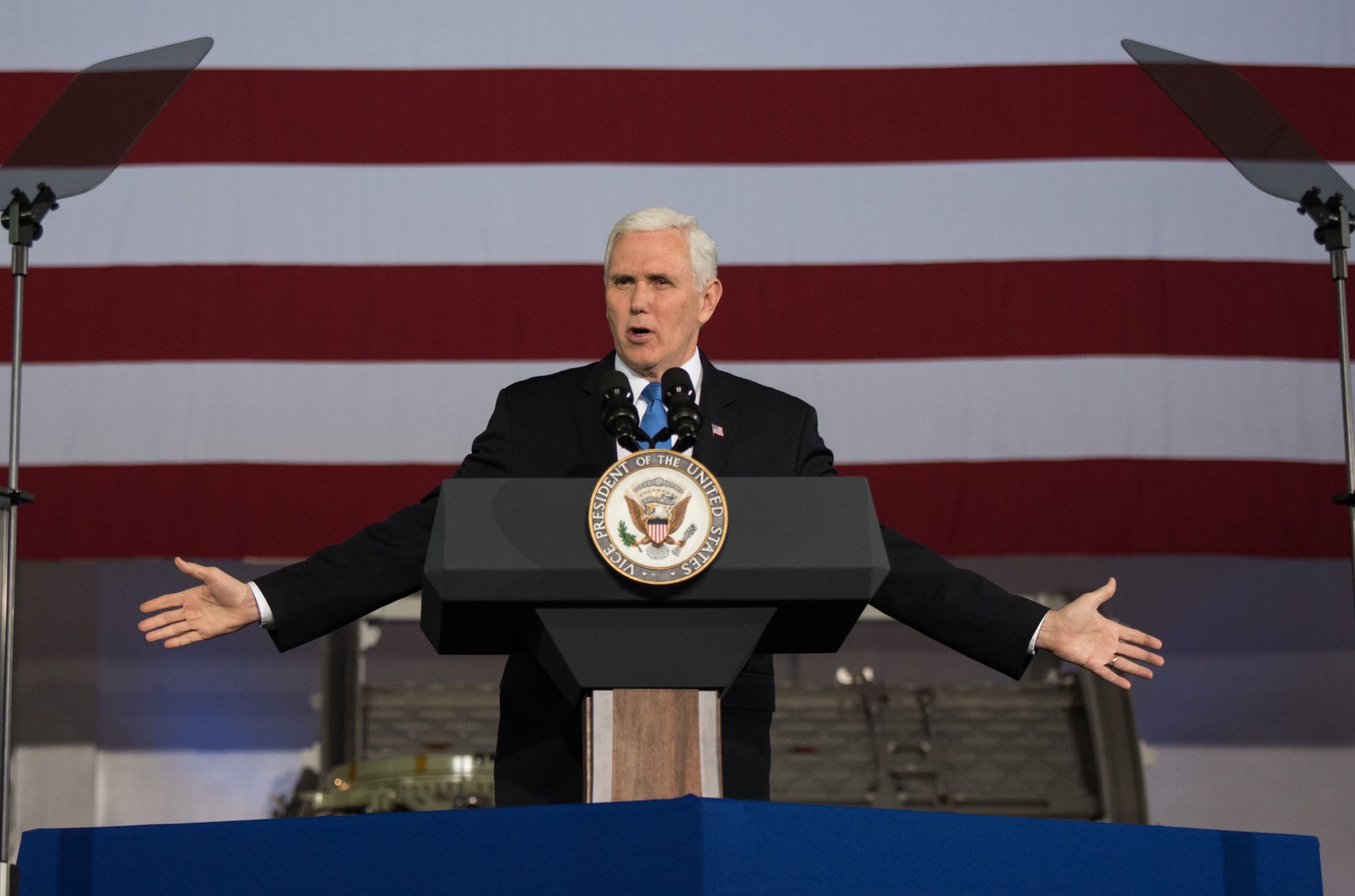
“Where Trump once defended free markets and expanded international trade, he embraced broad-based tariffs, protectionism and price controls on prescription drugs and credit cards.”
The sound of leather slapping marble will undoubtedly be the response of many Republican careerists today as they run from reporters and constituents wanting to ask questions about the stinging critique of President Trump by his former Vice President, Mike Pence, in a piece that is a shrewd call-back to Ronald Reagan: “A Republican Time for Choosing.” That piece, excerpted in The Wall Street Journal from Pence’s upcoming book, is a roundhouse punch of rhetoric, a philippic that catalogs the increasingly big-government populist agenda of the second Trump Administration.
Pence is sure to come in for attacks by the beehive of trolls and ghoulish influencers of the post-conservative populist right. But after reading this fact-based and well-reasoned piece, conservatives and Republicans should ask themselves: Do I really disagree with Pence?
Pence chronicles many—though by no means all—the ways in which Donald Trump’s personalistic agenda is antithetical to conservative principles.
“Where Mr. Trump once . . . wanted businesses to flourish in a free-market system, he brought about partial federal ownership of several corporations. Where he once wanted to engage with the world and lead, he has increasingly withdrawn from it and sought to isolate the U.S. from its longtime allies. Where he once defended free markets and expanded international trade, he embraced broad-based tariffs, protectionism and price controls on prescription drugs and credit cards.”
We would add that President Trump is firing off executive orders and ordering selective investigations to target political enemies—some of whom themselves were not adverse to misusing official powers against him—for possible prosecution. His regulators have pioneered new powers for the Federal Communications Commission and Federal Trade Commission by misapplying regulations and twisting rules to punish news organizations the president hates. They seem unconcerned that the next progressive administration will undoubtedly use these new powers to persecute conservative voices and outlets.
And this administration continues—without changing a jot or a tittle—the antitrust guidelines of President Biden and his FTC Chair, Lina Khan. Self-styled “Khanservatives,” from Vice President J.D. Vance to Sen. Josh Hawley, style themselves as Teddy Roosevelt-era progressives. The Missouri senator proposes vast expansions to the FTC’s powers and budget, and outlawing any mergers or acquisitions by large companies.
And these are the conservatives who call other Republicans “RINOs”?
At the heart of Pence’s critique is the distinction between principles and populism.
He writes: “Populists follow urges, not principles. They would erode our commitment to the Constitution and abandon U.S. leadership in the world.” Pence reminds us of a 2022 Truth Social post by Donald Trump justifying “the termination of all rules, regulations, and articles, even those found in the Constitution” to overturn what Trump called the “massive fraud” of the 2020 election.
This is the antipode of a conservatism that rests on a healthy skepticism of centralized authority and fierce opposition to personalized law. Conservatives recognize that free markets are not merely efficient mechanisms for producing wealth. They are also systems that disperse power, preserve individual liberty, and limit the ability of government officials to make economic decisions on behalf of millions of Americans.
The framework of conservatism is a governing philosophy rooted in constitutional limits, economic freedom, a strong national defense, and a recognition of human fallibility. Because people are imperfect, power must be constrained. Because government officials are no wiser than the citizens they govern (if that), decisions should remain as close as possible to individuals, families, communities, and markets.
Pence writes, “Rather than uphold American colonists’ rebellion against monarchical government, populism clamors for centralization to advance its version of the common good.”
Republican populism is progressivism in disguise. It strikes at us not just from a Democratic Party now wholly run by socialist progressives, but from within our own ranks, sparking a battle for the soul of the Republican Party.

This is a new reality but an old choice. In his “A Time for Choosing” speech, Ronald Reagan said:
“You and I are told increasingly that we have to choose between a left or right. There is only an up or down: up to man’s age-old dream—the ultimate in individual freedom consistent with law and order—or down to the ant heap of totalitarianism.”
Our choice is whether the GOP will be restored as the party of limited government, free markets, and constitutional principles, or continue to drift toward a form of populism that’s just a Trump-tinted version of what the other progressive party offers.