


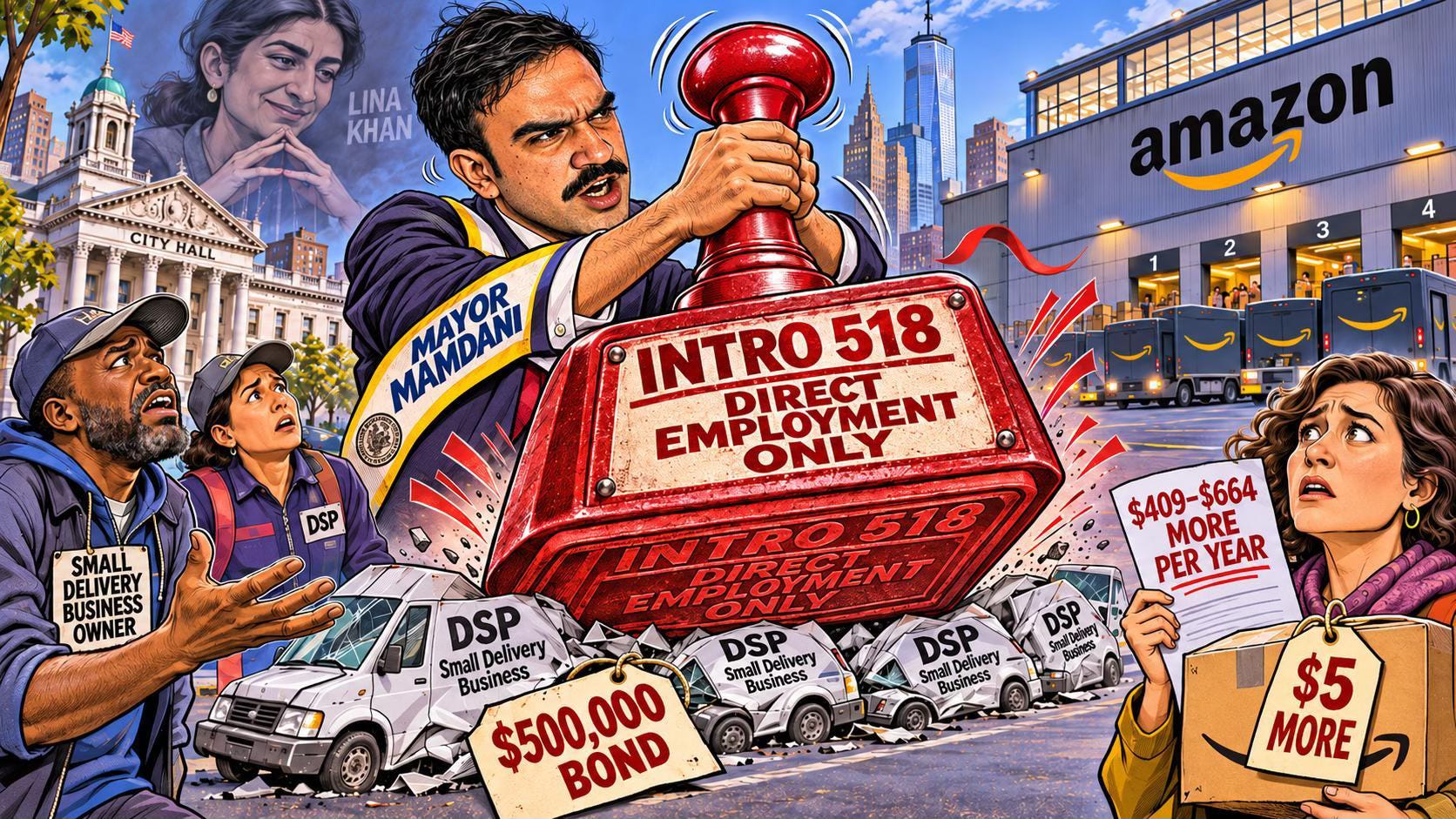
New York City has found a novel way to protect small businesses and their employees: put the businesses out of business and hope someone else hires the workers.
That is the logic of Intro 518, the Delivery Protection Act, now pending before the City Council. Sponsored by Council Member Tiffany Cabán, endorsed by Mayor Zohran Mamdani in August and pushed hard by the Teamsters, the bill would change how packages reach New Yorkers’ doors. It would also give City Hall broad authority over how private companies organize their work.
The main target is Amazon, which runs much of its last-mile delivery through independent Delivery Service Partners, or DSPs. These small companies hire drivers, manage routes and carry packages the final stretch from warehouse to customer. Amazon says it works with more than 40 of them in the city, employing more than 5,000 people. For many owners, a DSP is the first business they have ever run.
Under Intro 518, operators of covered last-mile facilities would generally have to employ their core warehouse and delivery workers directly instead of contracting with outside firms. The bill also adds licensing, safety, training and employment requirements. During a transition period, an operator that keeps delivery workers it does not employ would have to post a $500,000 bond for each one. For a company with hundreds of contracted drivers, that is less a bond than an eviction notice.
Lina Khan hovers in the background. Amazon has been her white whale since Yale Law School, where her 2017 note, “Amazon’s Antitrust Paradox,” made her name as a critic of corporate concentration. As chair of the Federal Trade Commission, she sued the company for monopolization. Since July she has chaired the board of the city’s Economic Development Corporation under Mamdani. Nothing public suggests she wrote the bill or is running the campaign for it, but the bill tracks her long-held views about Amazon’s power.
And here the argument turns on itself. To curb Amazon’s power, New York would wipe out the independent companies that stand between Amazon and its drivers, leaving Amazon to employ them all directly. For a movement worried about corporate concentration, that is an odd place to start.
The Teamsters say Amazon uses contractors to dodge responsibility for working conditions. They want drivers employed by the companies that control the delivery network, a change that would also make those drivers easier to organize.
The safety concerns are real. Drivers work punishing schedules in heavy traffic, at real physical risk. Employers should follow safety law, train their workers and answer for violations. None of that requires abolishing independent businesses. The city can set safety standards without dictating who may own a delivery company, and it can punish illegal employment practices without banning subcontracting. Subcontracting is ordinary commerce: manufacturers buy from suppliers, builders hire subs, retailers hire trucking firms. Specialization is how small firms win work they could never do alone. Intro 518 runs the other way, threatening the contractors’ business model and pushing employment up to the largest operators.
One of the sharpest objections has come from neither Amazon nor the business lobby but from Marc Morial, president and CEO of the National Urban League. In a November 10 essay for amNewYork, Morial warned that the bill would endanger thousands of jobs and a rare foothold for Black entrepreneurs in an industry where they have done well.
The numbers he cites: roughly 80 percent of the city’s last-mile workers are people of color, and an estimated 25 percent of delivery businesses are Black-owned, compared with 3 to 4 percent of businesses nationally. (Amazon’s own Council testimony describes 25 percent of its New York DSPs as owned by Black or Hispanic entrepreneurs, so the Black-only figure may run high.) Whatever the precise share, the bill would land hardest on an industry where minority ownership is unusually strong. A progressive administration that talks constantly about economic opportunity should be able to explain why it is willing to put that at risk.
Morial points to Ty Barnes, who left a corporate job to start NorthStar Logistics in the Bronx, where he grew up. Barnes has helped employees pay for tuition and civil service exams, and some have gone on to jobs at the MTA. A company like his represents savings, borrowed money and personal risk, and a way to build wealth in neighborhoods where owning a business has long been out of reach.
Morial supports stronger protections for drivers. What he rejects is the idea that protecting them means eliminating the companies that employ them, and he has asked the Council to drop the direct-employment mandate. Politicians who celebrate minority entrepreneurship at every ribbon cutting are backing a bill that a leading civil rights group says could destroy some of it.
Then there is affordability. Mamdani won by promising to make New York cheaper, and relief for struggling families was the core of his appeal. The bill he now backs could make daily life more expensive.
A June 2026 assessment by the consulting firm AKRF estimates that Intro 518 could raise costs by $409 to $664 per household per year if they are fully passed on to consumers, or up to about $5 more per package. These are projections, not observed price increases. The study was commissioned by the Five Borough Jobs Campaign, a coalition funded largely by Amazon, and its assumptions should be read with that in mind.
The underlying economics are not mysterious, though. Force companies to abandon their contracting arrangements for a costlier structure and someone pays: shareholders, workers, customers or some mix of the three. Companies may cut service, slow investment or move operations past the city line, and Amazon has already said it is weighing relocation. The exact result is uncertain. The tradeoff is not. For a family already stretched by New York prices, another $400 to $600 a year matters.
Mamdani’s affordability agenda should be judged alongside his regulatory one. A mayor who promises lower household costs while backing policies that may raise them owes voters more than a speech about corporate greed.
The workers the bill means to protect face their own risks. Intro 518 requires operators to offer jobs to contractor employees displaced by the transition. But a required job offer does not guarantee the same number of positions, the same operations or continued investment in the city. A driver whose employer has been legislated out of existence is not necessarily better off because the legislators promised a replacement.
The deeper error is confusing the protection of competition with government management of competitors. Competition is how businesses find cheaper and better ways to produce goods and serve customers. Some succeed and some fail. Consumers benefit from the experimenting, and smaller firms often find room to work alongside big ones.
The consumer welfare standard asks what a business arrangement actually does, not whether a powerful corporation is involved. It does not excuse unsafe workplaces or lawbreaking. It asks that remedies target identifiable harms without throwing away the benefits of competition.
If drivers need stronger safety rules, write and enforce them. If companies break employment law, investigate and prosecute. If Amazon is evading its legal obligations, apply the law. None of that requires City Hall to design the delivery industry.
New Yorkers want drivers to have safe jobs, entrepreneurs to have room to build businesses and customers to get affordable, reliable service. Intro 518 puts all three at risk for the sake of a single, government-prescribed employment model. Mamdani promised a more affordable city and a fight with corporate power. This bill could deliver higher prices, fewer independent businesses and an Amazon more vertically integrated than before.
That would be a peculiar victory over corporate concentration.