


For more than a century, Americans have celebrated the dignity of work on Labor Day. This year, however, the holiday arrives under a cloud. Artificial intelligence can write, code, analyze contracts, diagnose equipment and answer customer questions. If machines can perform work once reserved for human beings, some are asking, what will be left for us?
Is this, in effect, the last Labor Day?
Such predictions are as old as the Luddites. The steam engine was going to render human muscle obsolete. Mechanized farm equipment displaced millions of agricultural workers. Industrial robots replaced assembly-line jobs. Computers eliminated typists, switchboard operators and entire floors of clerical workers.
Each transformation caused real disruption. Some workers, like the artisans in Northern England who lost their markets to manufactured goods, never recovered what they lost. Some communities were left behind. We should not minimize that history or the human costs of Schumpeter’s “creative destruction.” But neither should we ignore the larger result: Technology did not eliminate work. It made workers more productive, lowered prices, increased incomes and created industries that earlier generations could not have imagined.
The mistake behind most predictions of technological unemployment is the assumption that the economy contains a fixed amount of work. If a machine performs a task, the reasoning goes, a human being must lose a job. But an economy is not a game of musical chairs. Greater productivity lowers the cost of producing goods and services. Lower costs create new demand. New demand leads businesses to expand, entrepreneurs to enter markets and capital to flow toward uses that did not previously exist.AI will operate through this same process, although probably faster than earlier technologies. It will eliminate some jobs, particularly those consisting largely of repetitive administrative tasks. The Bureau of Labor Statistics expects office and administrative-support employment to decline significantly over the coming decade. The disruption has already begun.
But a job is usually a collection of tasks, not a single activity. When AI takes over part of a job, it does not necessarily eliminate the worker. It can allow the worker to do more valuable work.
A doctor who spends less time preparing notes can spend more time with patients. A lawyer who can review documents in hours rather than days can take cases that were previously uneconomical. A small manufacturer can use AI to design products, monitor machinery and manage inventory without hiring a large administrative staff. A two-person business can acquire marketing, accounting and research capabilities that once belonged only to large corporations.
This is where many of AI’s new jobs will come from—not merely from building AI systems, but from the millions of businesses that will use them to expand.
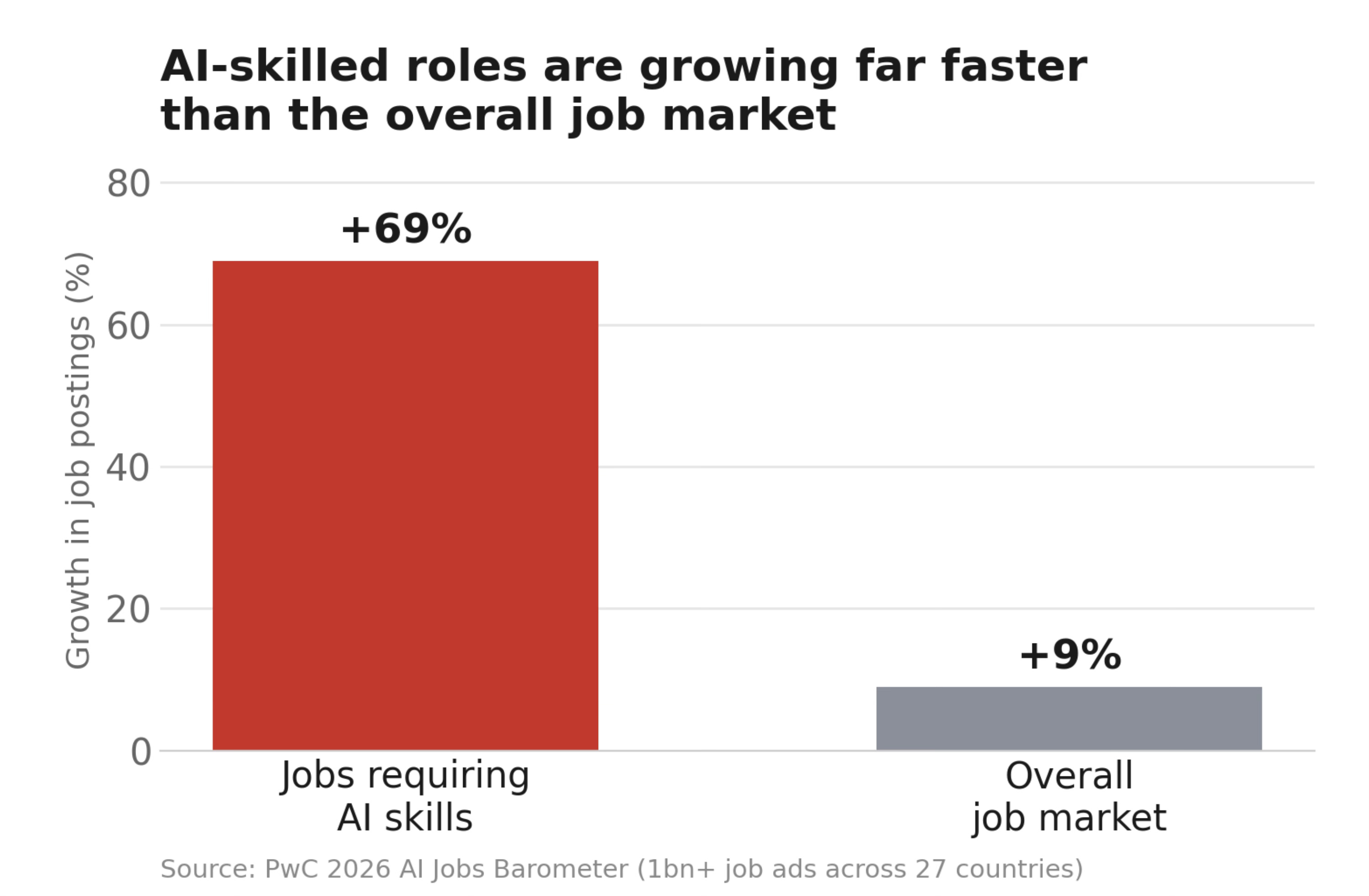
The evidence is beginning to support that view. PwC’s 2026 AI Jobs Barometer analyzed more than one billion job advertisements across 27 countries. It found that jobs requiring AI skills grew 69 percent while the overall job market grew 9 percent. Workers with AI skills commanded an average wage premium of 62 percent. More surprisingly, companies in the industries most exposed to AI increased their headcounts faster than companies in less exposed industries. These businesses were using AI to grow, not simply to cut payrolls. PwC’s study does not prove that every worker will benefit, but it hardly resembles a labor market approaching extinction.
The latest American projections tell a similar story. The Bureau of Labor Statistics expects the economy to add 5.9 million jobs between 2025 and 2035. Demand connected to AI systems, research and consulting is expected to help professional, scientific and technical services add more than 900,000 jobs. Computing infrastructure, data processing and web-hosting employment is projected to grow 25 percent and add roughly 120,000 jobs. Data-scientist employment is expected to rise nearly 35 percent. BLS also expects AI-related electricity demand to support jobs in power generation, electrical equipment, fiber optics and data-center infrastructure.
The most important effect, however, may be AI’s ability to make ordinary workers more capable. In a widely cited study of customer-support agents, researchers found that generative AI increased productivity by nearly 14 percent. The largest gains went to less experienced and lower-skilled workers, who gained access to knowledge previously possessed mainly by top performers. AI did not merely substitute for labor. It transferred expertise to workers who had not yet acquired it.
That could help reverse one of the least welcome features of the modern economy: the widening gap between highly credentialed experts and everyone else. AI can give a nurse, technician, mechanic, paralegal or small-business owner access to sophisticated analysis without requiring years of additional schooling. It can restore value to human judgment by supplying workers with better information on which to exercise it.

None of this guarantees a painless transition. Entry-level jobs may be especially vulnerable because AI can perform some of the routine work through which young employees traditionally learned a profession. Employers will have to create new forms of apprenticeship. Schools and community colleges must teach students how to work with AI rather than pretending it can be kept outside the classroom. Workers displaced in midcareer will need practical training tied to actual jobs, not vague promises of “reskilling.” And professors of English—well, they will just have to tear their hair out.
Government has a role in helping people make that transition. But it should not try to preserve every existing job description or decide which technologies businesses may use. Nor should Washington make America’s energy and permitting problems worse by blocking the data centers and generating capacity on which the new economy depends. If we refuse to build the infrastructure, the investment and jobs will go to America’s competitors.
The best protection for workers is a growing, competitive economy in which new companies can challenge incumbents and workers have many potential employers. Policymakers should therefore be suspicious of regulations that only the largest technology companies can afford to satisfy. Rules ostensibly written to restrain AI could instead entrench today’s dominant firms and prevent tomorrow’s employers from ever getting started.
Labor Day was not created to honor particular tasks or job titles. It honors the people who work, build businesses, solve problems and support families. AI will change how they do those things. It will also give many of them powers that previously belonged to corporations with thousands of employees.
So, this will not be the last Labor Day. But it may be one of the last on which we think of AI solely as a competitor to human labor. If we allow innovation and competition to do their work, AI can become a tool that enables Americans to create more, earn more and build jobs that do not yet have names.