


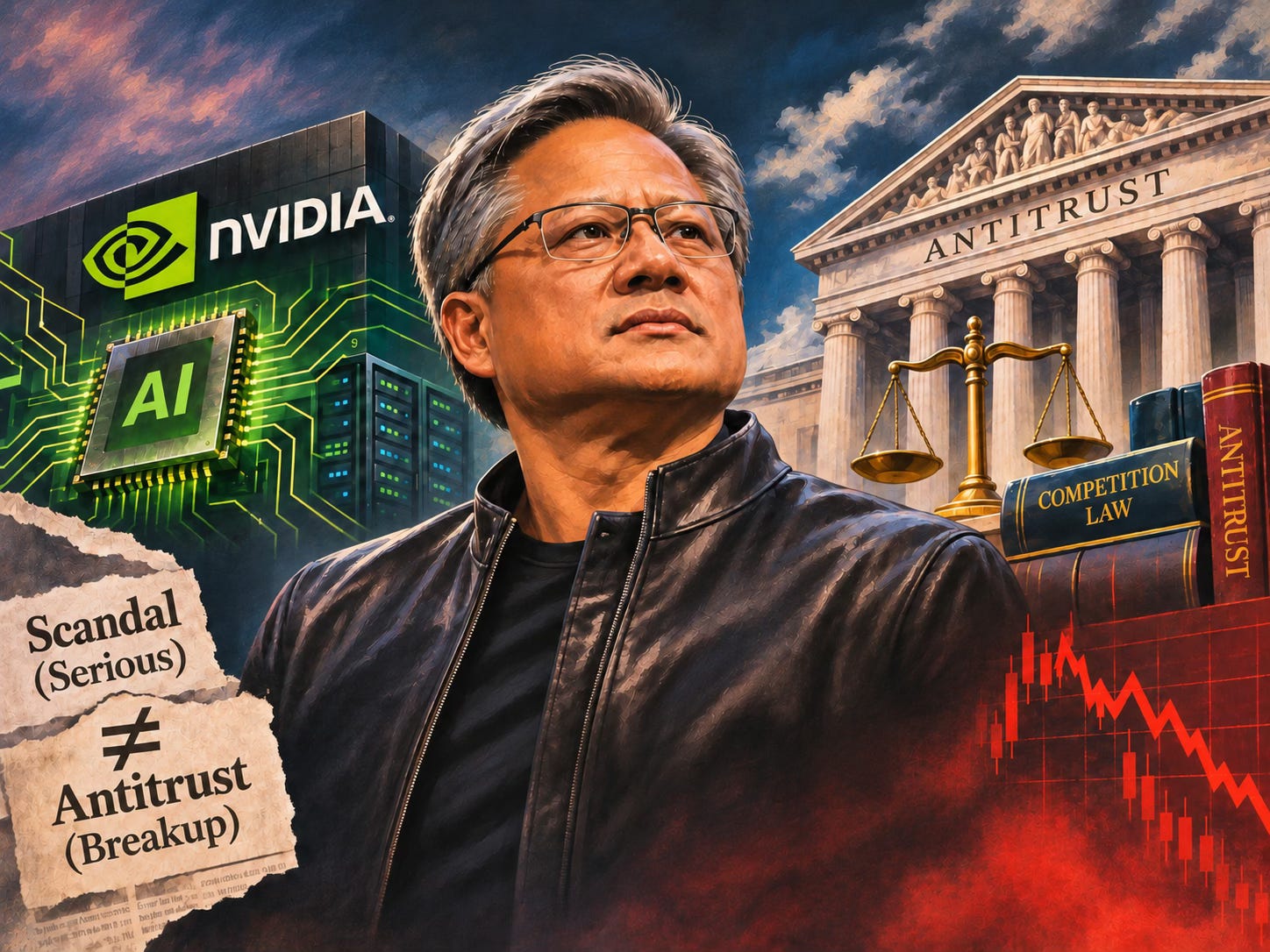
Nikolas Guggenberger, an assistant law professor at the University of Houston, has found an antitrust lesson in Jensen Huang’s private life. In an op-ed in the Los Angeles Times, he argues that the extramarital affairs of Nvidia’s former chief executive show how dangerous market concentration has become, and that the government needs to enforce the antitrust laws more aggressively.
The affairs are serious. Huang admitted to an affair with Alice Huang, a former Megaspeed executive whom U.S. officials suspect of working for Chinese intelligence, and reports of affairs with Nvidia employees followed. He resigned on November 12. Questions about his judgment, Nvidia’s governance and national security deserve answers, and the sell-off in Nvidia’s shares shows that investors are asking them.
Guggenberger’s argument runs like this: when a handful of people control the AI supply chain, one person’s failings become everyone’s problem. That is a claim about fragility and corporate governance. On its own, it is not an antitrust claim. Antitrust asks whether a firm has excluded rivals, restricted output, suppressed innovation, or harmed consumers, and whether a remedy would fix that harm. The op-ed does not identify any of these. It treats concentration as the offense.
Confusing the protection of competition with a preferred distribution of economic power is an old mistake. Antitrust law exists to protect the competitive process that produces lower prices, more output and better products. It was never meant to produce an industry of similarly sized firms.
Nvidia’s position came out of that process. For years, the company invested in technology with uncertain commercial prospects. Its graphics processors, and the CUDA software platform it began building in 2006, turned out to suit the computing demands of AI better than the approaches its rivals took. Customers bought them, and investors financed the expansion.
The law has to distinguish between market power won through better products and market power kept through exclusionary conduct. Erase that line and antitrust ends up punishing success. A company weighing billions in risky research would have to plan for the possibility that if its bet pays off spectacularly, the government will take it apart.
Guggenberger cites Friedrich Hayek’s observation that prices coordinate knowledge spread among millions of people and argues that concentration strips away the protection that this dispersal provides. But Nvidia’s rise is an example of that coordination at work. Customers, developers, engineers, and investors each made their own choices, and those choices put Nvidia where it is. His remedy is to have antitrust officials decide how the AI industry should be organized, which puts the decision in fewer hands, not more.
He is also suspicious of the investments and partnerships that tie Nvidia to other AI companies, including its stakes in OpenAI and Anthropic, and of vertical integration across chips, cloud capacity, models, and applications. He wants these ties untangled, and he endorses structural separation wherever one firm controls a bottleneck.
Integration often makes things cheaper and faster. Building AI means coordinating chips, software, data centers, electric power and capital at enormous scale, and partnerships are one way to do that. Such arrangements can also be used to shut out rivals, and where there is evidence of that, enforcers should investigate. Guggenberger does not point to a specific restraint, and he does not show that unwinding these relationships would leave the market more competitive.