

Editor’s Note: This recently appeared on Protect the First. We thought it typically excellent work. Enjoy!
What is left is right, and what is right is left – and both are getting it all wrong.
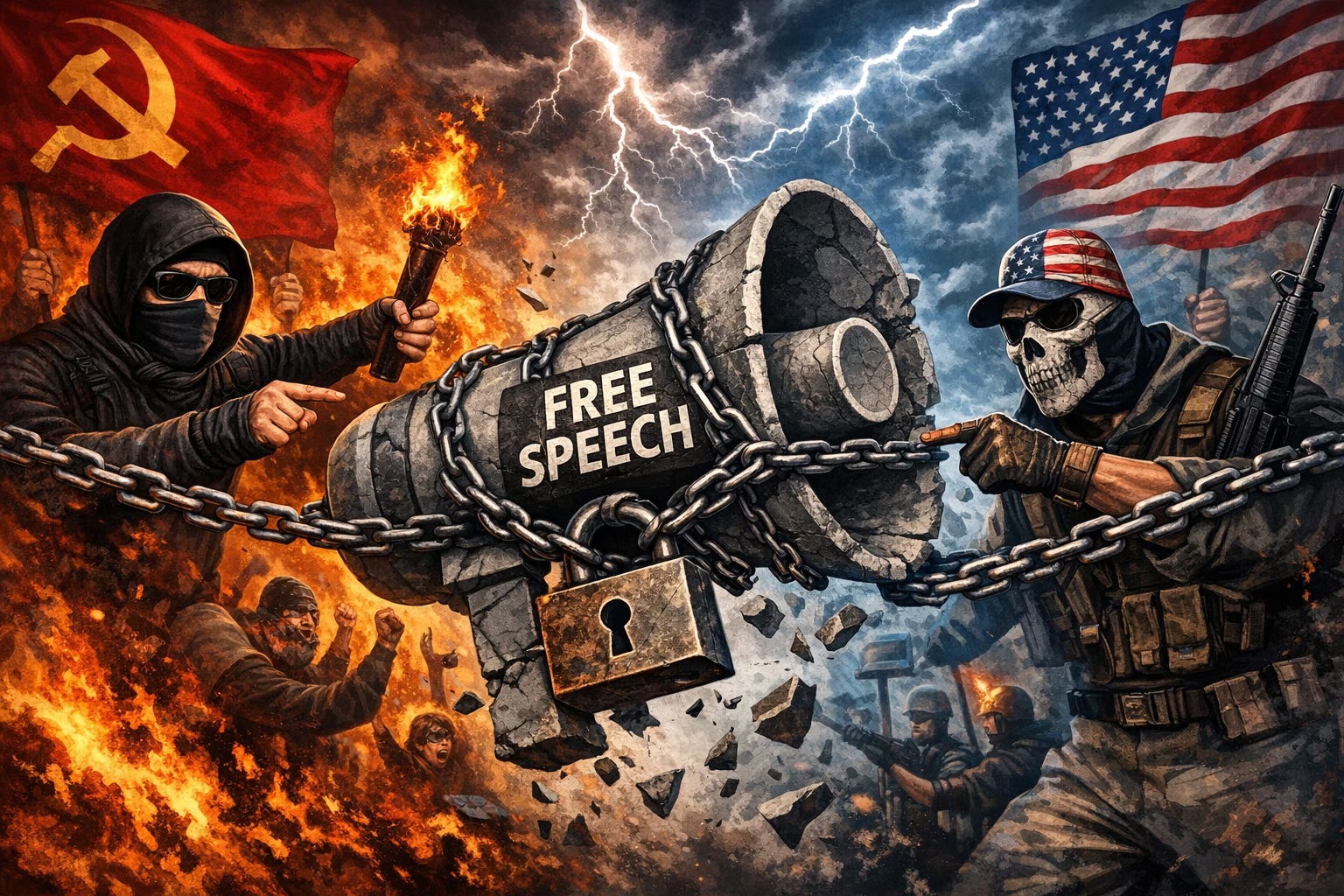
A convergence is taking place between the philosophies of some on the new right and the progressive left that treats social media as a “product” that must be regulated in the best interests of the American people, sweeping aside quaint concerns about the First Amendment guarantee of free speech.

We recently covered attempts by the Trump chairmen of the Federal Trade Commission and Federal Communications Commission to regulate journalism by overriding the First Amendment with appeals to consumer protection and airwave regulation.
This dovetails nicely with a recent New York Times op-ed by Tim Wu – who led the implementation of progressive policies from inside the Biden White House – arguing that social media is “a defective, hazardous product” that must be regulated “as a matter of public health.”
He echoes the reasoning of trial lawyers seeking to hold Meta, Google, Snap, and TikTok liable for harming youth. Wu lists a parade of horribles – “algorithmic recommendations, infinite scroll, auto video play and intermittent reinforcement (in which likes, comments, and refreshed content are rewarded unpredictably rather than consistently).”
Put aside, for a moment, the obvious lack of utility of a social media platform that doesn’t guide users to what they want to see, or that requires manual intervention to get something to play. Wu’s point here is that “the very design of social media is intentionally engineered to create compulsions and habits of overuse, regardless of the content provided.”
He adds: “Lofty platitudes about free speech ring hollow in the face of teenage depression, self-harm and suicide.”
Thus the circle squares, from Trump FTC Chairman Andrew Ferguson, who wants to apply consumer product regulation to Apple News, to Wu, who wants public regulation of social media to make it less harmful.
Wu is, to say the least, less than an ardent defender of free speech. He achieved notoriety with an essay that asked, “Is the First Amendment Obsolete?” (Short answer from Wu: yes.) There is also a more thoughtful side to Wu. He is right that American teens are too absorbed by social media, many dangerously so. But the solution, if there is one, could never come from government control of speech.
Several years ago, Elizabeth Nolan Brown in Reason magazine summed up the problem with blaming all the ills of the world on algorithms – which are, after all, a way to give users control of the content they see. Brown wrote:
It’s no secret that tech companies engineer their platforms to keep people coming back. But this isn’t some uniquely nefarious feature of social media businesses. Keeping people engaged and coming back is the crux of entertainment entities from TV networks to amusement parks…
Moreover, critics have the effect of algorithms precisely backward. A world without algorithms would mean kids (and everyone else) encountering more offensive or questionable content.
Brown quoted Meta’s former vice president of Global Affairs, Nick Clegg, who said that without the news feed algorithm, “the first thing that would happen is that people would see more, not less, hate speech; more, not less, misinformation; more, not less, harmful content.”
Algorithms pluck what users follow out of a torrent of billions of global messages. Without them, that torrent would hit us all in the face.
For reasons spelled out by Brown, Wu’s idea of turning over algorithmic control – and thus speech control – to law enforcement and trial lawyers has no hope of working. The same is true of the efforts of FCC Chairman Brendan Carr and FTC Chairman Andrew Ferguson to force journalists to adhere to their idea of greater ideological balance.
If either side ever succeeds in putting their schemes into action, they are sure to be disappointed when their controls fail to deliver the intended results. The obvious answer, to them at least, will be that even more control is needed. Then more.
Both ideological extremes are in a race to the bottom. Defenders of the First Amendment must be bolder than ever in declaring that speech is not a product – it is a human right.