


The following is an excerpt from Chapter 5 of my new book. Enjoy!
“The U.S. and EU ‘are at a moment of convergence’ on antitrust.” —Margrethe Vestager, European Commission
“‘The winds have changed’ on regulating U.S. tech companies.” —Gerard de Graaf, EU envoy to Silicon Valley
“The Trump administration is troubled by reports that some foreign governments are considering tightening the screws on U.S. tech companies with international footprints. Now, America cannot and will not accept that, and we think it’s a terrible mistake not just for the United States of America, but for your own countries.” —Vice President J.D. Vance
Europe is failing, perhaps dying. And it wants us to die with it.
Europe’s decline is partly based on demographics. Women in the European Union are having fewer children, well below the replacement rate, creating ghost towns in Tuscany and leaving factories idle in Germany. The most talented European youth and energetic entrepreneurs, from Budapest to Paris, are stymied by overregulation, crushed under strict hierarchies and credentialism that border on a caste system.
The results of Europe’s stultified society are evident in Mario Draghi’s report on European competitiveness. The former Italian Prime Minister found that 30 percent of European startup businesses that become “unicorns,” those growing to more than €1bn in valuation, move abroad. The vast majority of European unicorns emigrate to the United States.
This happens because a skein of regulations, restrictions, and high taxes imposed by Brussels and London is choking the innovation of European youth and the prospects for economic growth. Fifteen years ago, the European economy was 10 percent larger than that of the United States. By 2022, the U.S. economy had grown by 72 percent. China’s economy had grown by almost 300 percent. The European Union grew over this time by only 21 percent.
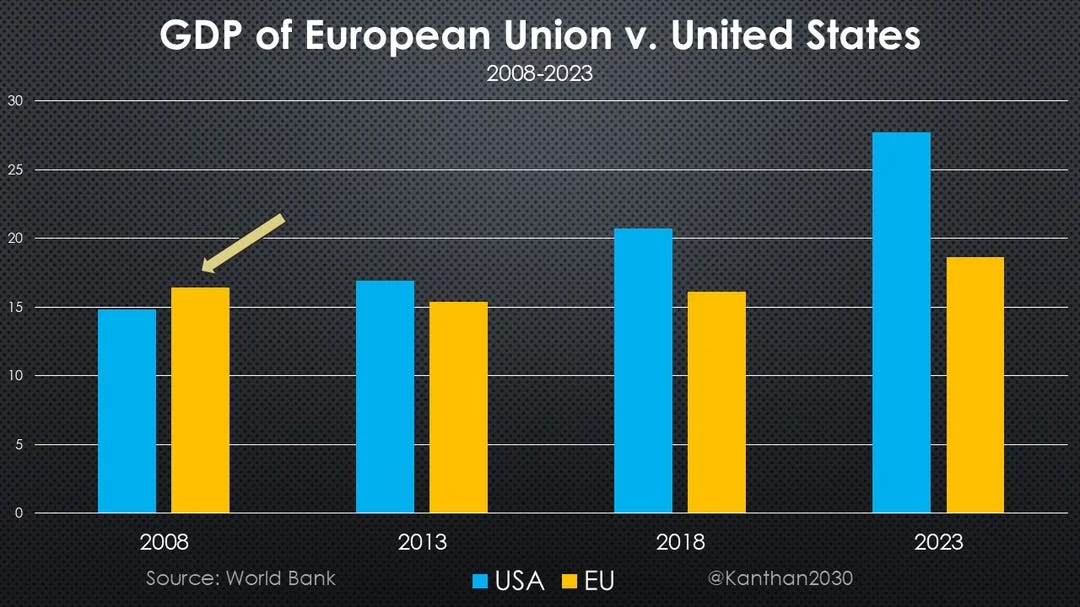
As result, the European economy is now 23 percent smaller than that of the United States. This is the result of a deliberate and vitiating embrace of progressive regulatory theories like those embraced by Khan and Khanservatives. Rep. Scott Fitzgerald, a Republican from Wisconsin, captured the essence of global economic trends: “America innovates, China replicates, and Europe regulates.”
As Europe fails, the Eurocrats in Brussels have chosen not to find ways to liberate the innovation of youth and the animal spirits of their entrepreneurs. They have, instead, chosen to dedicate their energies to the regulation of wealth instead of wealth creation. They have especially embraced antitrust policy as a way to degrade and perhaps destroy U.S. competitiveness. Europeans now have the mindset of the proverbial Russian peasant who would rather kill a neighbor’s cow than buy milk from that neighbor, or better yet, invest in a calf.
It is easy to see how Europeans, with progressive ideology, got themselves into this mental cul-de-sac. The mystery is why so many Americans on the left and increasing numbers on the right are supporting this economic warfare against American business, jobs, and consumers.
Criminalizing American Innovation
The main targets of Europe’s ire are America’s most innovative companies – Apple, Alphabet/Google, Amazon, Meta Platforms/Facebook, Nvidia and other technology leaders. Many European regulators, like much of the blogosphere, see these companies as if they were nothing but the playthings of a few billionaires. But America’s technology sector is the nation’s sharp edge in global leadership in business and a core driver of our national defense. Tech employs almost 10 million people in the United States. It generates hundreds of billions of dollars in returns annually to the portfolios of tens of millions of U.S. retirees.
These companies provide the bulk of our nation’s research and development. Alphabet (Google) invested more than $45 billion in R&D in 2023, Meta almost $40 billion, Apple $30 billion. Amazon invested a whopping $85 billion into research and development in that year. The pharmaceutical company Merck directed $30 billion into creating life-enhancing and life-saving compounds. These companies operate as venture capitalists, encouraging the larger ecosystem of small innovative startups whose founders hope to be acquired by a large company that can commercialize their discoveries and make them billionaires. It’s a powerful incentive program and it has maintained the status of the United States as the world’s technology leader since the 1990s.
Europe has a meager tech ecosystem. It has no equal to Apple, no “Pomme,” or any other European company with the stature of an American Big Tech companies. Rather than look within to understand Europe’s failure, as Draghi did, European regulators have convinced themselves that the success of these American companies can only be attributed to some form of competitive predation. If these American companies are so big and successful, it must be due to abusive monopolies. So slaughter their cow!
The European Union’s blade is the Digital Markets Act, that targets the major “gatekeepers” of the digital economy – the providers of online search engines, app stores, and messenger services. China’s ByteDance is the only one of the EU’s current targets to be defined as a gatekeeper that is not American. The others are the usual suspects – Alphabet, Amazon, Apple, Meta and Microsoft.
The European Parliament also passed the Digital Services Act, a rule to strengthen consumer privacy. The practical effect of these two laws together is to require gatekeepers, a.k.a. American tech companies, to allow third-parties, including competitors, to interoperate with their services. They forbid these American companies from preferencing their own services and products over those of competitors and other third parties.
The new laws have some neutral and arguably beneficial consumer aspects, such as allowing advertisers to verify the results of their ads, and expanding the privacy rights of consumers. But overall, the Digital Markets Act would evaporate the profit centers of U.S. tech. In essence, European law says to American technology companies – quit being businesses! European regulation threatens to transform major U.S. social media platforms into so many versions of low-profit Reddits at best, and into regulated public utilities at worst.
The draconian nature of the new regime can be seen in the EU’s treatment of Meta, the owner of Facebook and Instagram, which was hit with a €200 million fine in April 2025. Meta had responded in 2023 to the Digital Markets Act by creating a pay-or-consent model. This model offered European users of Facebook and Instagram the option of giving their explicit consent to be tracked in exchange for a free service funded by ad revenues, as is the case in the United States. Or European users could have chosen to step out of that model and pay a modest sum for an ad-free service.
The “pay or consent” option was a major restructuring of Facebook’s European business. It went into effect without official feedback. Then the EU ruled that giving such a choice to consumers to be a violation of the Digital Markets Act, and levied its massive fine on Facebook for its good faith attempt to comply with the law. Facebook was then told by Europe to offer a free service with no way for the company to support it.
Thus new EU law utterly disrupts how U.S. companies exchange free services (like Facebook) for being able to monetize the user’s data (employing anonymized IDs to match ads of interest in one’s feed). It is being forced to deny consumers the option of providing a paid alternative. The EU’s fines on Meta are now close to €1 billion.
This is just one of the ways the European Union is determined to enforce its Digital Markets Act to outlaw the basic business models that made Apple, Google, Meta, Microsoft, and Amazon America’s most innovative companies. They are now explicitly targeted by this law as digital “gatekeepers” in need of wholesale restructuring into social media utilities.
If this still strikes you as hyperbolic, consider what the EU is doing to Apple.
Apple has invested more than $100 billion in recent years to produce products that are seamlessly and safely linked, providing levels of security and privacy valued by consumers worldwide. Central to Apple’s success is the willingness of developers to create new apps with powerful capabilities for Apple customers. But Apple enforces conditions on developers. They are granted a degree of access to Apple systems, but not so much that they can steal Apple’s proprietary algorithms or – most importantly for antitrust – access and exploit user data.
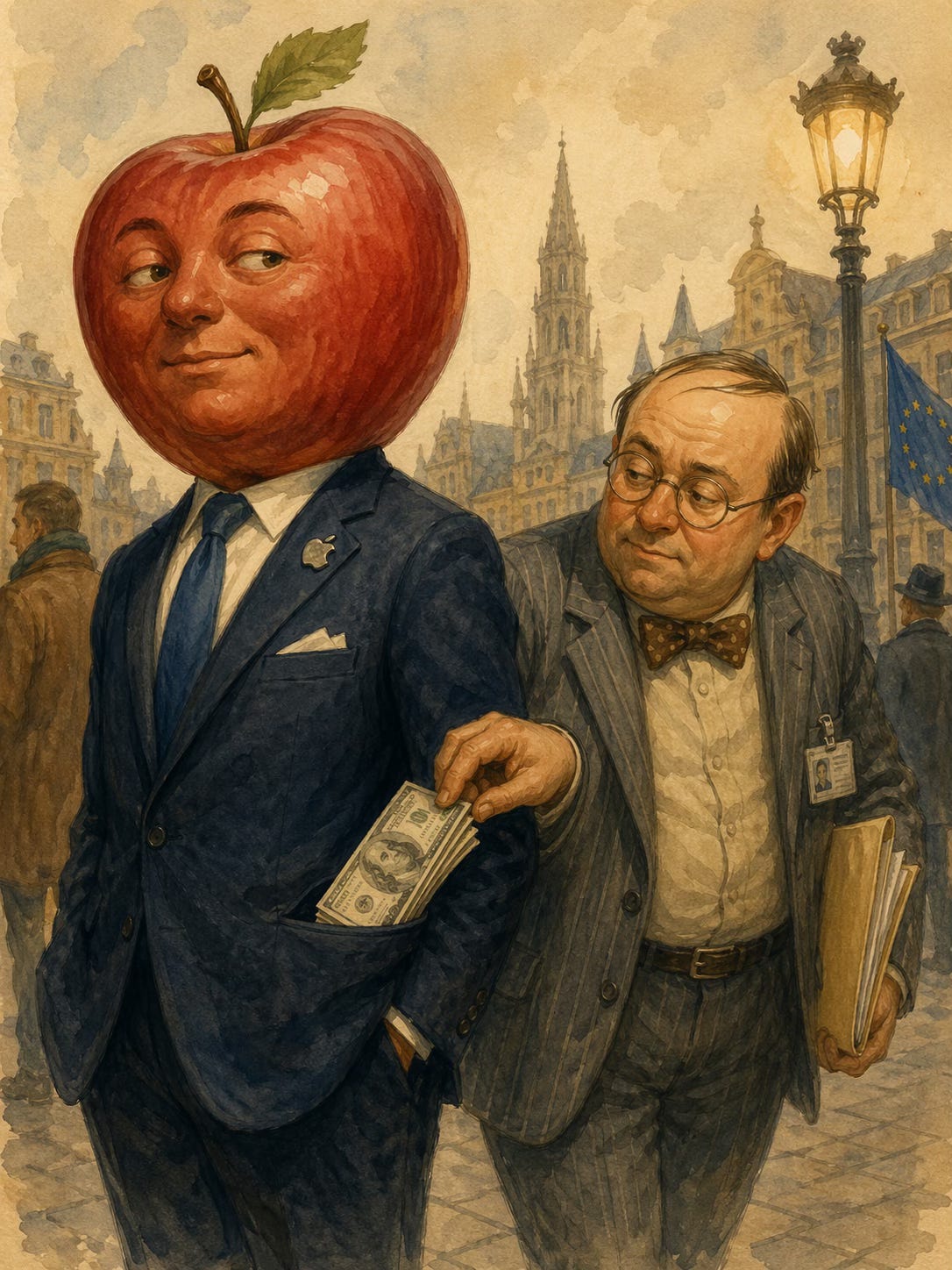
For example, when developers create apps that rely on sound, Apple requires them to ask users for their permission before accessing their microphones. If developers want to record audio, they also must get explicit permission. Similar guardrails are in place for apps used for banking, gaming, and a variety of content and services. Developers can access Apple’s Touch ID, but they cannot access data in the Secure Enclave inside the iPhone. Not even Apple can access it. Apple could be likened to a bank that will allow access to a vault room, but won’t allow rifling through safety deposit boxes.
Taken literally, the law’s demand for “interoperability” with developers and competitors attempts to force Apple to throw open the safe deposit boxes and expose consumers’ most sensitive data. The EU mandate would allow access to consumers’ communications over iMessage – whether 6-digit codes texted by banks, Wi-Fi passwords, or personal communications. Also at risk is data on AirPlay, CarPlay, and Siri. Every message, email, phone call, image, and calendar will be potentially exposed to myriad developers, sure to be exploited and likely to be resold on the international market. Thus, Europe, in the name of protecting consumers, is forcing the exposure of users’ data, commoditizing it in the name of interoperability. It is a virtual certainty that some buyers will be cut-outs for China. As the FBI has warned, China “uses elaborate shell games” and overweight voting rights to control companies without tipping off its real ownership.
What is Apple’s crime? Apple was accused of not allowing app developers to steer customers to alternate platforms owned by competitors. In other words, Apple is being told to provide a platform for competitors – and pay for it. This is not unlike walking into a shop and telling the shop owner to allow his competitors to set up booths in his store. This intrusion threatens the carefully cultivated culture of Apple. That company’s appeal to consumers rests on its curation of a high-quality store for its apps. Steve Jobs, as Apple’s founder and creator, was especially adamant that Apple would keep pornography out of its shop. But European regulators, knowing better, forced Apple to admit a competitor, AltStore. Now, thanks to the EU, European customers of the iPhone or their children can access curated pornography from across the web thanks to AltStore’s HotTub app.
Apple, along with Meta, was an early target of Digital Markets Act fines. The European Commission slapped Apple with a €500 million Euro penalty, despite Apple’s strenuous efforts to comply with the law. European regulators said that Apple must remove technical and commercial restrictions that prevent app developers from steering users to cheaper deals outside the App Store. Apple complained: “We have spent hundreds of thousands of engineering hours and made dozens of changes to comply with this law, none of which our users have asked for. Despite countless meetings, the Commission continues to move the goal posts every step of the way.”
Microsoft came under investigation for its Teams collaboration video and chat software on its Microsoft 365 platform. What raised European suspicion? Microsoft was accused of being a moral monster for packaging a new product with other of its products and for trying to entice consumers to adopt them. Thus, practices that are perfectly normal for most European, “non-gatekeeper” companies are somehow considered malevolent tying when American tech “gatekeeper” companies employ them.
Not only is Europe challenging the business model of America’s leading companies, under Europe’s new Digital Markets Act, these companies can be hit with fines that threaten their very existence. This may not sound credible, given the size of U.S. Big Tech companies. But consider: Fines are not levied on an American company’s profits in Europe. The DMA’s penalty is a 10 percent fine imposed on an American company’s turnover or revenues – worldwide. A second infraction elicits a 20 percent fine of an American company’s worldwide revenues. Meta CEO Mark Zuckerberg told Joe Rogan that Europe has fined U.S. tech companies more than $30 billion.
Winding up for the monumental fines of the DMA, the Dutch Data Protection Authority, acting under the auspices of the DMA, last year fined Uber $324 million for transferring some customer data to servers in the United States during a time when the company’s obligations were unclear after the European Court of Justice had struck down the U.S.-EU Privacy Shield Agreement. Meta was fined $1.3 billion for a similar infraction. These massive fines were imposed despite no violation of the privacy of a single European. Fines of such magnitude bleed off money that could be better spent on innovation and more product choices for consumers.
You might think that regulation in the United Kingdom after its Brexit departure from the EU would sure be more rational. Oddly, the withdrawal from the EU did not stop Britain – for years under supposedly market-friendly Tory prime ministers – from internalizing the progressive ideology of the EU. Consider how the UK’s Competition and Markets Authority (CMA) stepped in to prevent Meta from acquiring a company called GIPHY, which provides the limited function of searching for short, GIF-like files with limited movement. Why did the British CMA intervene to block this merger? It claimed a loss of competition in the U.K. ad market. British regulators, however, suppressed facts, including the most telling one of all: GIPHY had failed to sell a single ad in the U.K. market.
Why is Europe out to wreck America’s leading companies? It seems to be out of a mixture of progressive thinking and anti-Americanism. Consider: In the first quarter of 2024, the largest seller of smartphones in Europe is Samsung, with 37 percent of the market. Add to that China’s Xiaomi market share, and the two Asian giants have a combined 53 percent share of the European smartphone market. And yet it is Apple’s 22 percent share in Europe that somehow defines it as a “gatekeeper” in need of radical restructuring. These latest fines for violating the DMA are eye-popping, but they continue an anti-American trend that has resulted in roughly $8.7 billion in fines imposed on another top American innovator, Google, over the past decade.