


What Would Bork Do About Baseball?
His antitrust philosophy usually gets counted on the owners’ side. On baseball’s exemption, it points the other way.
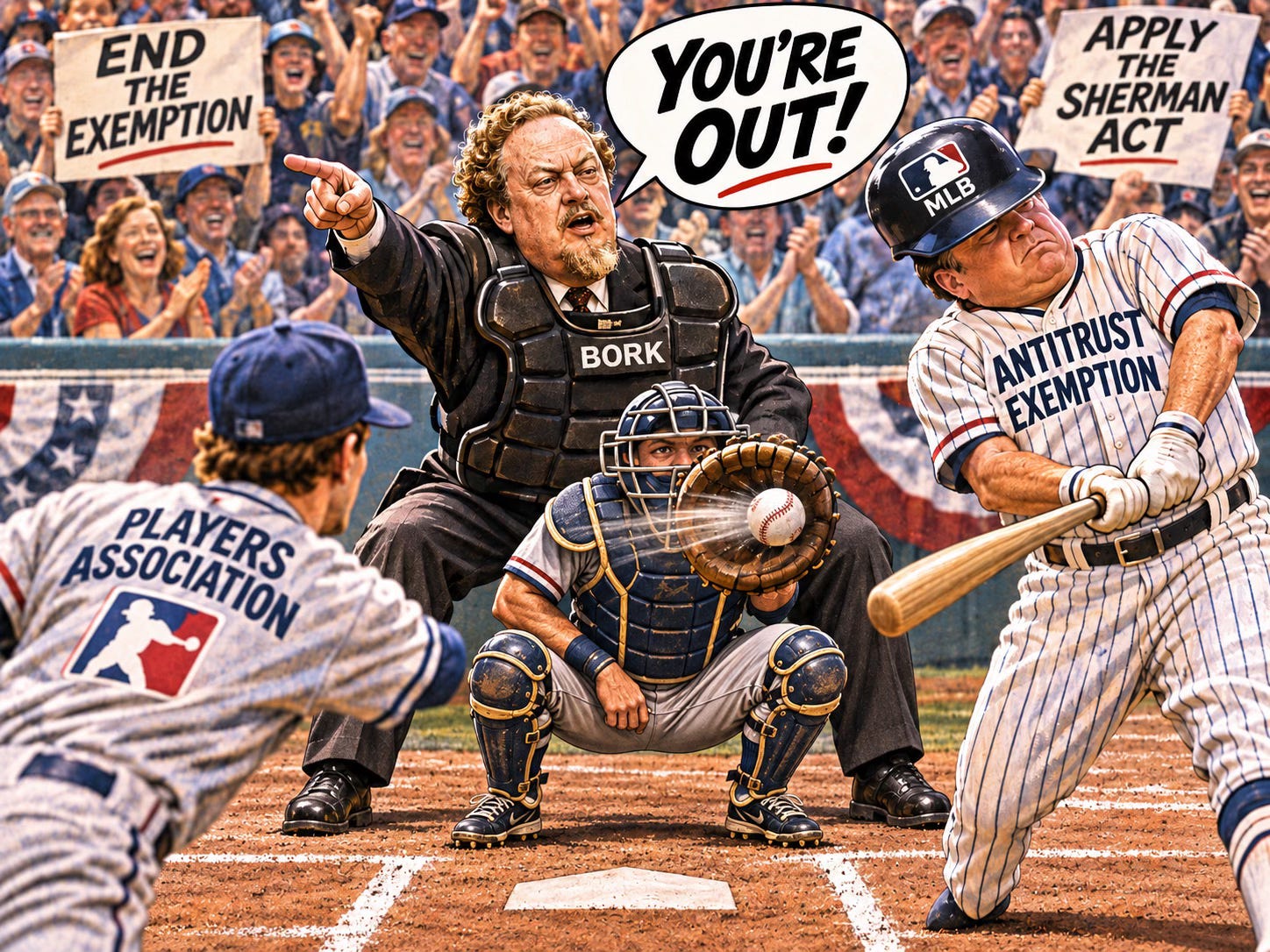
My dad is the patron saint of antitrust restraint. His 1978 book, The Antitrust Paradox, persuaded courts that the antitrust laws have one job: protecting consumer welfare, meaning efficiency and output, not shielding small competitors or redistributing wealth. Conservatives have cited it for decades whenever regulators reach for a bigger stick. So, you might expect a Borkean to defend Major League Baseball’s century-old exemption from antitrust law. He wouldn’t.
The question is live again. On November 10, Sen. Dick Durbin introduced the Competition in Professional Baseball Act, with Sen. Mike Lee, a Utah Republican, as a cosponsor. It would put baseball under antitrust law on the same terms as football, basketball and hockey. The players’ association endorsed it, and owners are expected to lock the players out next week on December 2.
Baseball’s exemption is a judicial invention. In 1922 the Supreme Court held that putting on baseball games wasn’t interstate commerce, so the Sherman Act didn’t apply. The Court later called that an aberration, kept it anyway in 1953 and 1972, and said fixing it was up to Congress. Congress made a partial fix in 1998 by putting major-league players’ employment under antitrust law. Minor-league employment, the draft, and franchise relocation and ownership are still exempt. In March the Court passed up another chance to overrule the 1922 decision.
A Borkean would object on two grounds. My father wanted judges to apply the statutes Congress wrote, and the Sherman Act has no carve-out for baseball. The exemption rests on a reading of “commerce” that no one defends today. His whole method was also to ask what a business practice does to consumers, and the exemption exists to keep that question from being asked.