


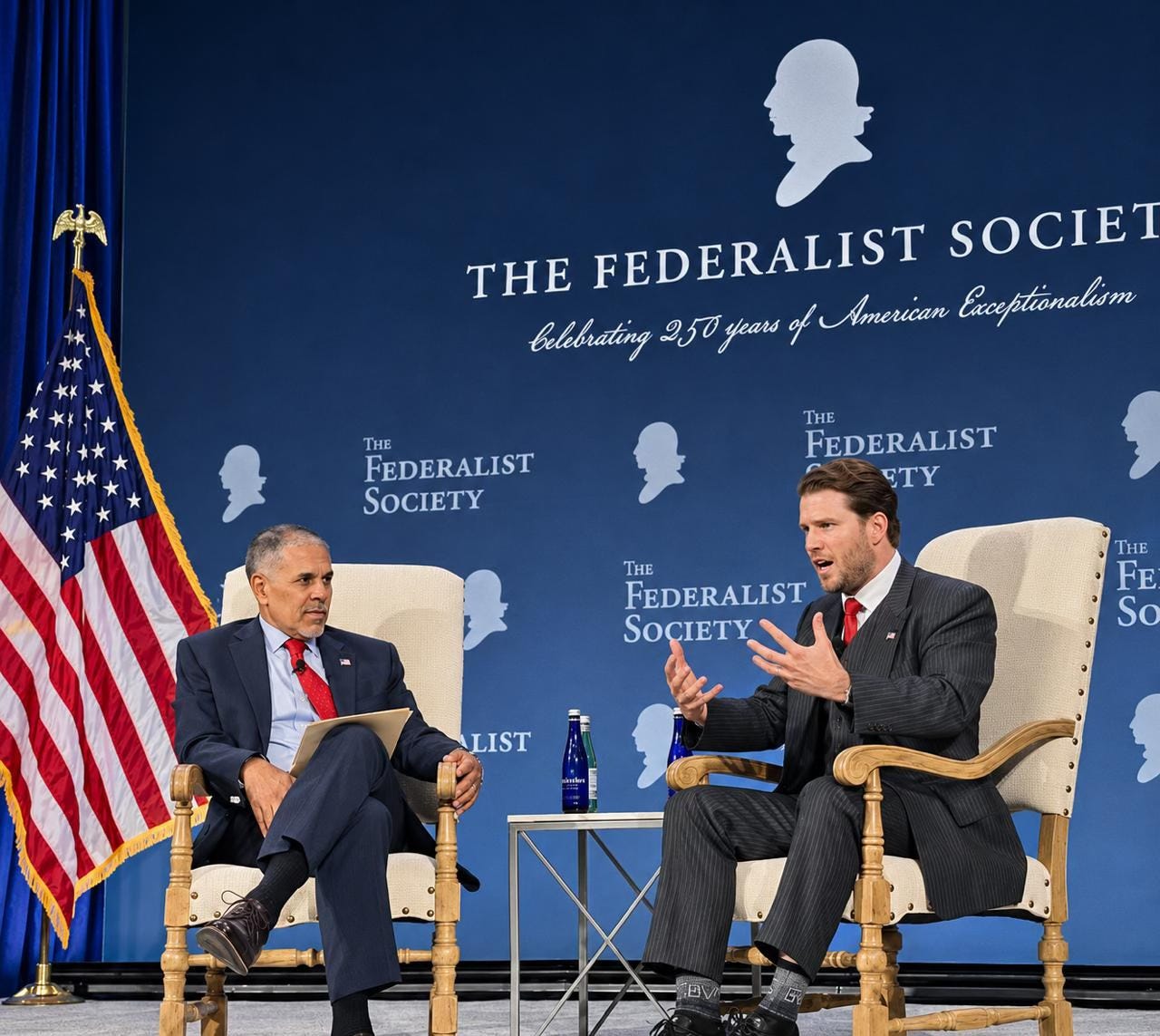
This year’s Robert H. Bork Memorial Lecture at the Federalist Society’s National Lawyers Convention, brought together two people who approach the world from very different directions but share a concern for the preservation of liberty. Judge Amul Thapar, of the United States Court of Appeals for the Sixth Circuit, moderated a lively conversation with Joe Lonsdale, the entrepreneur and investor who co-founded Palantir and several other innovative enterprises.
The lecture, titled Consent of the Governed, ranged across artificial intelligence, the regulatory state, competition, national security, and the future of the legal profession. Lonsdale was an energetic and often provocative advocate for the extraordinary possibilities of AI, while Thapar repeatedly pressed him on the constitutional principles that must govern its use.
Lonsdale’s enthusiasm for technological innovation was infectious. He sees AI as an instrument for expanding human freedom, making government more accountable, and giving individuals and small businesses capabilities once reserved for large institutions. He described how technology could expose regulations lacking statutory authority and dramatically reduce compliance costs that discourage entrepreneurs from challenging established businesses.
His observations about competition were particularly welcome. Lonsdale expressed agreement with Robert Bork’s consumer welfare approach to antitrust and warned that established AI companies may seek regulations that protect them from emerging competitors. As he put it, large businesses often welcome regulation because it makes life more difficult for potential rivals. It was a timely reminder that government intervention can suppress competition just as surely as private anticompetitive conduct.
Thapar raised an equally important question about the ideological assumptions embedded in AI systems. Invoking Bork’s commitment to neutral principles, he asked how judges and ordinary citizens can rely on technologies that may reflect the political preferences of their creators. Lonsdale favored transparency and competing AI models that challenge one another’s assumptions. His answer was not to suppress disagreement but to expose it to scrutiny.
The discussion was especially illuminating when it turned to the courts. Thapar insisted that judges must remain responsible for their decisions, regardless of the sophistication of the technology assisting them. Lonsdale agreed, imagining a future in which judges have access to extraordinarily capable AI assistants offering competing legal arguments, but retain the obligation to evaluate those arguments and decide cases themselves.
The conversation did not always return to its announced theme of consent of the governed, nor did it dwell extensively on Bork’s jurisprudence. Nevertheless, it raised questions that would have interested him enormously. How do we preserve neutral principles when machines increasingly shape the information on which decisions are based? How do we prevent government from using regulation to protect established economic interests? And how do we ensure that technological power remains subject to constitutional limits?

Lonsdale’s optimism offered a useful counterweight to the increasingly fashionable view that technological progress is something to be feared and restrained. Thapar supplied the necessary reminder that the benefits of innovation do not relieve us of the obligation to preserve the institutions of self-government.
The Bork Memorial Lecture is intended to encourage serious consideration of the principles of liberty, constitutional government, and economic freedom. This year’s conversation demonstrated how relevant those principles remain as we confront technologies that would have been unimaginable only a generation ago.
The challenge is not to choose between innovation and liberty. It is to ensure that innovation serves liberty rather than diminishing it.