


When President Trump nominated Adam Candeub to lead the Justice Department’s Antitrust Division, it seemed like a win for conservative legal enforcement. Candeub has an impressive résumé and a serious intellectual pedigree. His Senate questionnaire records a career teaching law and serving at the Federal Communications Commission and the Commerce and Justice departments. He has written extensively about telecommunications, competition and the internet. His work reflects familiarity with Robert Bork, Milton Friedman, Frank Easterbrook and the law-and-economics tradition. He is not a novice who stumbled into antitrust through politics.
But a closer inspection of Candeub’s nomination should prompt more careful scrutiny from conservatives.
Candeub appears increasingly willing to loosen his standards when they obstruct the administration’s political objectives. He retains the vocabulary of consumer welfare, economic freedom and error costs, while admitting into antitrust a growing catalogue of noneconomic concerns—free speech, democratic resilience, children’s development, corporate ideology, and even human happiness.
Each of those concerns is important. None becomes an antitrust concern merely because a large company is involved.
In his chapter on the Federal Trade Commission for Project 2025, Candeub accurately describes my father’s contribution: placing consumer welfare at the heart of competition law. He also writes that the consumer-welfare standard “must guide FTC action.” So far, so good. But that sentence continues. In appropriate cases, he says, the standard “must be expanded” beyond price. He then discusses concentration’s effects on free speech, the marketplace of ideas, shareholder control, managerial accountability, democracy and children’s development. Elsewhere in the chapter, he suggests that social media’s tendency to make users unhappy may justify a more aggressive regulatory response.
Those qualifiers are a problem.
The consumer-welfare standard has never been confined to whether the price of a widget rises by a nickel. Properly understood, it encompasses output, quality, innovation and consumer choice, including nonprice harms when they result from injury to competition. But it is still a limiting principle. It requires the government to identify a relevant market, prove anticompetitive conduct, demonstrate injury to the competitive process and connect that injury to consumers.
Once “consumer welfare” is expanded to include every social consequence attributed to a powerful corporation, antitrust enforcement breaks free of all constraints. An enforcer can simply select the political concern of the moment and redescribe it as a competitive harm.
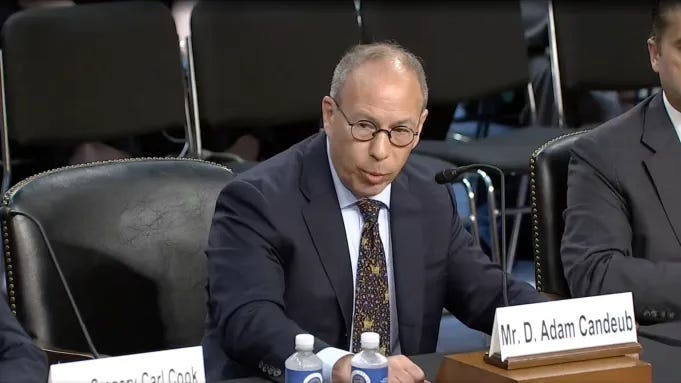
Candeub made the tension unusually clear in 2023 testimony before the Senate Judiciary Committee. He praised the economics-based consumer-welfare standard for limiting the damage caused by mistaken or overly broad enforcement. But he immediately contrasted that discipline with Big Tech’s alleged effects on democracy, free speech and children. Discussing the removal of Parler from major app stores and Amazon’s hosting service, he asked whether proposed antitrust legislation would produce a “freer country” and a “stronger democracy.”
The exclusion of a rival from indispensable distribution channels can present a legitimate antitrust issue. If dominant firms conspire or use monopoly power to suppress competition, the law supplies a remedy. But whether a platform treats conservative speech fairly is not, by itself, an antitrust question. The Antitrust Division should not become a national board of editorial appeals.
Candeub’s communications scholarship reinforces these concerns. In a 2020 Yale Journal of Law & Technology article, he described Section 230 as part of a “regulatory bargain”: government provides liability protection while dominant networks accept antidiscrimination duties and furnish public goods, including a platform for free speech. That theory is thoughtful and has deep roots in common-carriage law. It may provide a basis for legislation governing communications networks.
But common carriage and antitrust are not interchangeable. Common-carrier duties arise from a distinct body of law and normally require legislative authorization. Antitrust, by contrast, condemns agreements and conduct that damage competition. Combining the two invites the government to treat successful technology companies as public utilities and impose neutrality obligations without first proving an antitrust violation.
Candeub’s treatment of Frank Easterbrook’s error-cost framework is equally revealing.
Easterbrook warned that erroneous intervention can suppress efficient conduct for years, while monopoly profits ordinarily attract entry and innovation. Candeub acknowledges that logic, then changes the calculation: failure to intervene, he argues, may injure democratic accountability and free speech, making a more proactive approach appropriate.
This sounds cautious, but it removes the denominator from error-cost analysis. How is an antitrust court to measure injury to democratic deliberation? How should it balance political viewpoint, childhood well-being and consumer satisfaction against efficiency? These are questions on which reasonable citizens disagree and for which antitrust law possesses no special competence. Once they enter the calculus, enforcement turns on an official’s political judgment rather than administrable economic evidence.
There is an irony in Candeub’s reliance on Milton Friedman. He invokes Friedman to condemn managers who spend shareholder resources advancing their own social and political beliefs. That criticism may be justified. But Friedman’s deeper point was that market mechanisms, rather than political officials, should allocate private resources.

Using government enforcement to punish corporations for the wrong ideology would reproduce the very politicization Friedman opposed.
Conservatives understandably resent Silicon Valley’s censorship, ideological conformity and occasional cooperation with government. I share many of those concerns. But the answer to politically directed antitrust is not politically directed antitrust with a different enemies list. A progressive administration handed Candeub’s expanded theory could just as readily target companies for insufficient commitment to climate policy, organized labor, diversity or “democratic resilience.” Political antitrust does not remain conservative when political control changes hands.
The stakes are particularly high at the Justice Department. The Assistant Attorney General decides which mergers receive searching review, which companies face civil monopolization suits, and which executives confront criminal investigation. Even when the government eventually loses, an investigation can consume years, alter business strategy and impose enormous reputational and financial costs. A standard that permits the enforcer to consider a company’s politics creates both uncertainty and an invitation to seek political favor.
That is how “America First Antitrust” could become the conservative version of the Neo-Brandeisian project: different preferred constituencies, different disfavored corporations, but the same belief that antitrust officials should reorganize markets in pursuit of political ends. It is also how antitrust becomes an instrument of the conservative socialism I have criticized—government directing private enterprise according to political priorities rather than protecting the competitive process.
None of this proves that Candeub would misuse the office. His writings contain genuine caveats, respect for economic evidence and recognition of the risks of overenforcement. That distinguishes him from those who reject consumer welfare outright. His intellectual seriousness is real. The question is whether his limiting principles are.
The Senate should therefore ask him for commitments, not labels.
Will he challenge conduct only when the government can prove injury to competition and consumers under existing law?
Will he disavow viewpoint discrimination, corporate ideology and generalized effects on democracy as independent grounds for antitrust action?
Will he keep common-carrier regulation and Section 230 reform out of the Antitrust Division unless Congress supplies clear authority? And will he apply the same standards to politically friendly companies as to politically hostile ones?
If Candeub can answer yes, his experience and intellectual background could make him a formidable Antitrust Division leader. If he cannot, senators who believe in law and economics should oppose his confirmation. The issue is not whether Big Tech deserves sympathy. It is whether antitrust law still deserves a boundary.