


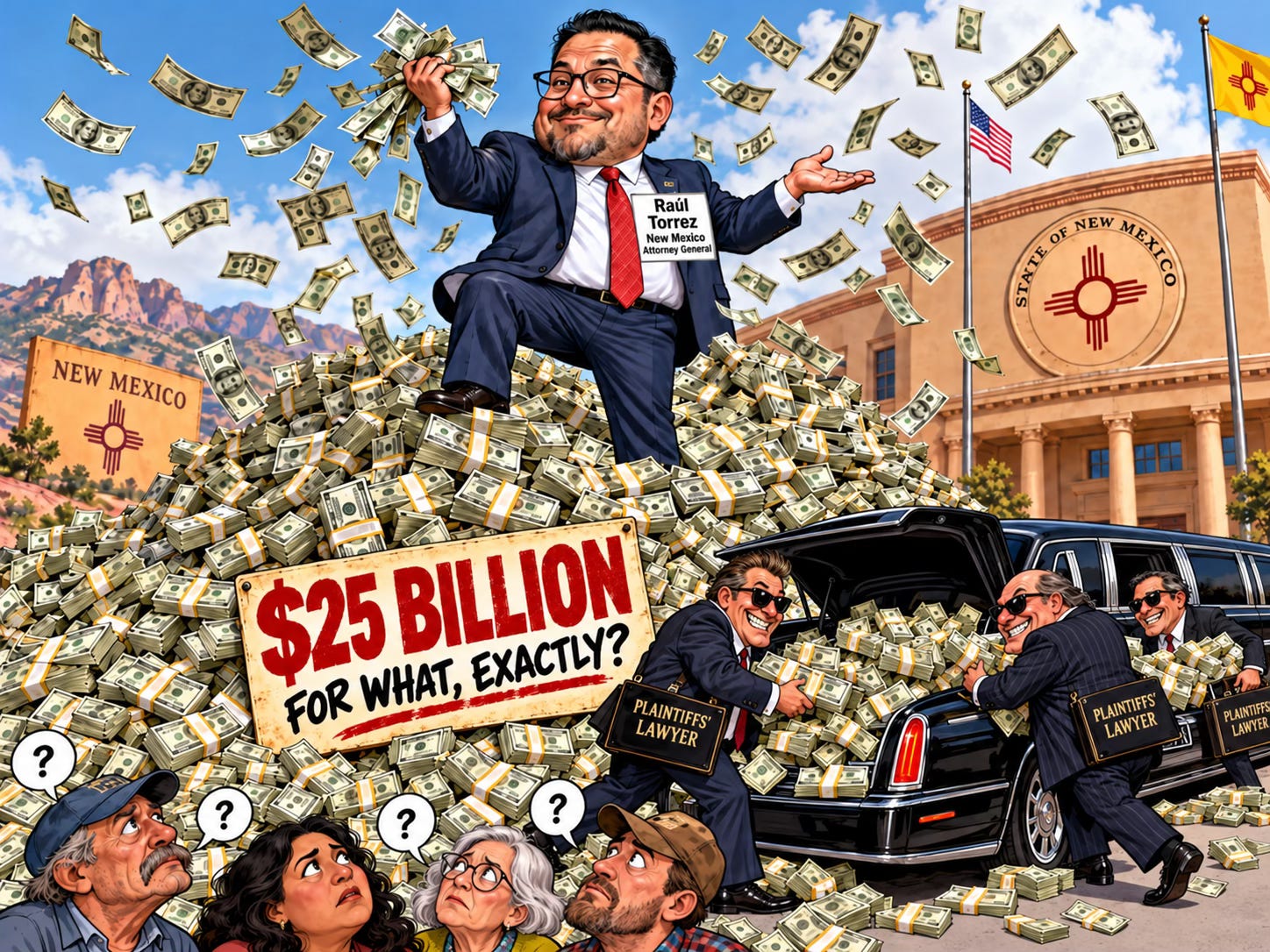
New Mexico has just ordered Meta to pay $25 billion for violating the state’s consumer-protection laws. Not $25 million. Not $250 million. Twenty-five billion dollars, plus 15 percent interest a year until the company pays. Attorney General Raúl Torrez calls it “one of the largest, if not the single largest state verdict against a company in American history.” Because the state constitution sends such penalties to education, he says New Mexico “may have paid for the construction of schools for the next 100 years.”
That ought to buy some very nice schools. The more interesting question is whether New Mexico has any business collecting the money in the first place.
The case grew out of the Cambridge Analytica scandal. A Santa Fe jury considered 34 counts based on public statements by Facebook and its executives about users’ control of their data, hate speech and misinformation, community standards, favored treatment of government figures, and the company’s promised post-scandal investigation. It sided with the state on 31 and found nearly 44 million violations of the Unfair Practices Act. Judge Francis Mathew applied the statute’s $5,000 maximum to each, roughly $219.5 billion, then reduced the total to $25 billion. The state had sought $35 billion to $40 billion; Meta argued that anything above $3.45 billion would be unconstitutional.
Let’s begin with something that should not be controversial. Companies that deceive consumers should be held accountable, and Facebook has no special dispensation to misrepresent how it handles personal information. There is nothing inconsistent about defending free enterprise while insisting that businesses tell their customers the truth.
But there is a considerable difference between punishing deception and turning a few dozen corporate statements into a $25 billion payday for state government. That is where this case becomes troubling.
New Mexico’s Unfair Practices Act permits civil penalties of up to $5,000 for each willful violation. But the statute does not answer the rather important question of what constitutes a violation.
Suppose a company publishes a misleading statement on its website. Has it committed one violation? One violation each time it repeats the statement? One violation for every consumer who actually sees it? Or one violation for everyone who might conceivably have encountered it?
Those distinctions are not academic. They are the difference between a $5,000 fine and a judgment large enough to finance a modest sovereign nation.

Consider how the jury got there. For each statement that appeared in major news outlets, the jury assigned 2.1 million violations, roughly New Mexico’s entire population. For each statement on Facebook’s own channels, it assigned 1.4 million, the estimated number of New Mexicans on Facebook in 2020. The count rested on potential audiences, not on anyone shown to have seen or relied on anything. Residents who never opened a Facebook account became a separate violation for every statement that reached the news.
New Mexico argues, with some justification, that a corporation should not escape meaningful punishment because it deceived millions of people through one communication rather than millions of individual falsehoods. Fair enough. But that does not make every potential recipient of a statement another punishable offense, much less someone who never saw it at all.
The distinction matters especially when the government collects the proceeds. Torrez did not choose where this money goes; the state constitution sends it to education. But a state that knows every penalty dollar will fund its classrooms has a standing incentive to count violations generously. This single penalty is more than twice the $11.1 billion general-fund budget New Mexico enacted for the current fiscal year. If fiscal interest is allowed to shape how violations are counted, every ambitious attorney general will be tempted to discover a few billion new violations hiding in a corporate press release.
The incentive may not stop with the state. New Mexico’s case was tried by private plaintiffs’ lawyers from the Albuquerque firm McGinn Montoya Love Curry & Sievers, and the terms of their contract have not been made public. In the state’s separate youth-harm case against Meta, the attorney general’s office says its outside firm is entitled to no more than 7.12 percent of the award. If the same rate applied here, the lawyers’ share would come to about $1.8 billion. New Mexicans deserve to know whether the people who built the count of 44 million violations stood to profit from making it bigger.
The Constitution imposes limits as well. BMW v. Gore and State Farm v. Campbell concern punitive damages rather than statutory penalties, an important distinction. But in St. Louis, Iron Mountain & Southern Railway v. Williams, the Supreme Court recognized that a statutory penalty can violate due process when it is “so severe and oppressive as to be wholly disproportioned to the offense and obviously unreasonable.” And Timbs v. Indiana confirmed that the Eighth Amendment’s Excessive Fines Clause binds the states.
Judge Mathew justified the maximum per-violation penalty by citing the number of willful violations, their duration and repetition, the breadth of subjects, the involvement of senior Facebook leadership, the size of the audiences reached, and the intentional, systematic nature of the misstatements. Several of those findings deserve real weight. If senior executives knowingly misled the public for years, that matters.
But notice one item on the list: the size of the audiences reached. Audience size is what produced 44 million violations in the first place. Using it again to justify the highest penalty per violation counts the same factor twice.
New Mexico will respond that $25 billion is far below the theoretical maximum, which makes the judge appear positively merciful. But a penalty does not become reasonable merely because it is smaller than an even more fantastic number. If the counting method is flawed, cutting the result by nearly 90 percent does not cure it.
Nor is $25 billion the final figure. The judgment accrues 15 percent interest annually, so every year spent on appeal adds roughly $3.75 billion to the bill. A defendant with a strong constitutional objection should not have to weigh the merits of its appeal against a penalty that grows faster than most investments.
Some of the challenged statements also concern Facebook’s content moderation. A knowingly false representation about a company’s practices can be actionable. A government’s disagreement with how a platform exercises editorial judgment is another matter; in Moody v. NetChoice, the Supreme Court recognized those judgments as protected expression. States cannot evade that protection by dressing their objections in the language of consumer protection. Meta’s chief legal officer, C.J. Mahoney, puts it more bluntly: the lawsuit, he says, “seeks to impose a tax on speech to enforce new rules for what people can say online.” That overstates things, since the verdict rests on findings of specific misrepresentations. But he has a point.
The jury itself drew some of these lines, rejecting the state’s claims about statements on graphic violence, fake COVID cures, fact-checking, and posts promoting hate crimes or terrorism after Charlottesville. Statements about content moderation are not all alike, and the moderation findings that remain deserve especially careful review.
Meta says it is confident it “will prevail on appeal,” and it should appeal. Mahoney also warned that the ruling and the attorney general’s approach make it “all but impossible to do business in the state of New Mexico.” Losing defendants always say something like that. But this time the warning deserves a hearing.

Torrez himself concedes that the Unfair Practices Act was designed for an era that no longer exists, and he plans to ask the legislature to restructure it. That is the right forum. If New Mexico wants penalties built for the digital age, its legislature can write them. Courts should not create them after the fact by redefining what counts as a violation.
Until then, the old law is producing consequences no legislator intended.
First, a cap has become a multiplier. The Unfair Practices Act dates to 1967, when deception usually meant a salesman’s pitch or a misleading newspaper ad, and its $5,000 limit was meant to keep penalties in check. In the internet age, it does the opposite.
Second, one state can now punish national speech. Many of the statements at issue appeared in national news outlets, and nothing in New Mexico’s logic stops at the state line. If every state adopted its method, the same sentence in the same news story could be punished fifty times over.
Third, going it alone pays. This summer, Meta settled youth-harm claims brought by 47 states for up to $17.1 billion, plus a separate $1.05 billion deal with Texas. New Mexico stayed out to pursue its own cases, and a single privacy judgment has now brought it more than all of those states combined. Other attorneys general will notice, and coordinated, predictable resolutions will become harder to reach.
Finally, and most paradoxically, a law meant to give consumers better information may leave them with less. If every public statement about privacy or content policy can be multiplied by a state’s population and priced at $5,000 a head, the rational corporate response is to say less: fewer public commitments, vaguer policies, more carefully lawyered language. Consumers misled by false promises have a real grievance. Consumers who receive no promises at all are not better off.
The larger concern extends well beyond Meta. State attorneys general increasingly use consumer-protection laws to shape how national businesses operate. California has made something of a specialty of this, and New Mexico appears determined not to be outdone. A law intended to protect consumers from deception can become an instrument for imposing regulatory preferences, extracting enormous payments, and punishing politically convenient targets. The danger is not that large companies will be held accountable. It is that accountability will cease to bear any recognizable relationship to the violations actually established in court.
There is a respectable case for punishing Meta if it knowingly deceived consumers. There is also a respectable case for requiring New Mexico to explain precisely how it arrived at 44 million violations and why they justify $25 billion in punishment.
The rule of law demands both.
Until that explanation survives appellate scrutiny, the question remains: $25 billion for what, exactly?